ZANZIBAR’S CHIEF MINISTER’S WARNING

Zanzibar Chief Minister, Mr. Seif Shariff Hamed, has blamed the restive political situation in Zanzibar on disgruntled elements who are disillusioned by the socio-political changes which have steadily. whittled away their personal prestige and economic interests. Mr. Hamad, who was visibly angry, told Police and investigating officials at a meeting on July 7th that he denied allegations that, by accepting aid from Gulf countries or by liberalising trade and investment policies, the Zanzibar Government had abandoned socialism or compromised on the isles’ sovereignty.

He said the ongoing economic and structural reform were for the public good and not intended to blindly embrace capitalism or hand over Zanzibar to foreigners as claimed by its detractors. He described the disproportionate opposition to the Government’s policies as crocodile tears by those who had hitherto thrived on political terror and exploitation of the islanders – Daily News

OBITUARIES

The death has been announced of two well known persons who have had a big impact on Tanzania. They are Sir Michael Wood and Dr. Bernhard Grzimek.

Dr. Michael Wood was for several years a farmer at Ol Molog in Tanzania but made his name by starting the first ‘flying doctor’ service in East Africa. In order to combine the two tasks he is understood to have flown in and out of his farm nearly 800 times before he had to give it up after the Arusha Declaration.

Dr. Grzimek died in Frankfurt while watching tigers train at a circus. He became internationally famous because of the assistance he gave in establishing Tanzania’s Serengeti and Ngorongoro game sanctuaries and in spreading news about them around the world.

He was quoted as saying on one occasion, “Men fight and die to change borders and convert others to their way of life. My son and I must surely be right to work and risk our lives to help save the Serengeti”

They first came to Tanzania in 1957 and after learning to fly, carried out the first aerial survey of animals in the Serengeti. They counted a total of 366,980 large animals.

Dr. Grzimek campaigned ceaselessly for the preservation of wildlife. He once wrote “Men are easily inspired by human ideas but they forget them again just as quickly. Only nature is eternal unless we senselessly destroy it. In fifty years time nobody will be interested in the results of conferences which fill today’s headlines. But when, fifty years from now, a lion walks into the red dawn and roars resoundingly, it will mean something to people and quicken their hearts whether they are Bolsheviks or democrats, or whether they speak English, German, Russian or Swahili. They will stand in quiet awe as, for the first time in their lives, they watch twenty thousand zebras wander across the endless plains.”

Dr. Grzimek’s ashes were buried on May 26th in Ngorongoro crater next to the grave of his son Michael. Michael had died thirty years earlier while filming ‘Ngorongoro Shall Never Die’. Park rangers fired a gun salute at the burial ceremony. The Government has agreed to build a ‘Bernhard Grzimek Memorial Centre’ at Seronera in his honour.

SUNDAY DRIVING BAN LIFTED

The Government has lifted the ban on Sunday driving imposed in 1974 to control the usage of fuel following rocketing oil prices. The Government indicated that it believed that recovery efforts would be expedited if citizens, including those with motor vehicles, were able to travel to and participate in agricultural activities on Sundays ..

Oil consumes more than half of Tanzania’s foreign exchange earnings and the driving ban had contributed to savings. Sunday News writer Adam Lusekelo indicated however that, for some people things would not really change.
“Our strategy was classified material” he wrote “but now that the ban has been lifted, we might as well narrate some of our ban beating manoeuvres.

“We approached the road block in our rickety pick-up. As was expected, the car cop stopped us with great authority. He stood in the middle of the road. I thought that was foolhardy because half the Dar es Salaam cars don’t have brakes.
License?
We showed it to him.
Registration card?
He got that too.
Sunday driving permit?
That is when all of us concentrated on our supporting roles to the star – the young lady we were with. She ‘inexplicably’, burst into tears. The rest of us wore long and sorrowful faces.
What’s wrong? asked the now flabbergasted cop.
Its just that (..sniff..), it’s just that … one of us renowned for his acting skills moaned, we have been to a funeral …
The magic word funeral worked. You know how we rally to each other when it comes to funerals.
He let us through.
True enough there was drink and fresh air at the beach hotel. And lots of official cars too – their owners on duty quaffing beer.
Or you can try something else.
The best method of all was to buy a football. No, not to play with. You tie it round the girl’s midriff and make sure that she is wearing a maternity dress …… “

PARLIAMENTARY MATTERS

The National Assembly had something of a marathon budget session recently. It lasted six weeks. Once again members took advantage of their freedom of expression. A few extracts from the debates:

The Member for Kyela. “Why are interest rates on loans for agricultural purposes so high despite Government’s resolve to promote agricultural production?”
Reply: Interest rates for the agricultural sector are always below those paid by Banks to their clients. Bank clients were paying 24% compared to between 20 and 22% for loans for the agricultural sector. Beginning July 1987 short term loans for villages and primary co-operative societies have been 20% Mid and long-term loans for small village projects have an interest rate of 21%

The Member for Muleba: “What steps is the Government taking to reduce the gap between low and high income earners in accordance with the Arusha declaration?”
Answer: Recent salary reviews were intended to reduce the gap. In 1960 the ratio had been 1:20. Now it is 1:5.9.

The Member for Tarime pleaded with the Government to stop deporting cattle rustlers from the Mara region to Mtwara, Ruvuma and Lindi. The Government was wasting a lot of money on this. “When these people come back after serving their terms they are graduates. It is as if they went to learn new techniques. They should be deported, their property sold, and the Government should let the people of Mara solve the problem themselves by employing ‘Sungu Sungu’ or by killing the thieves”.

The Member for Tunduru suggested that coconut thieves in the Southern regions should be banished to the Mara and Kilimanjaro regions where the crop is not grown.

The Member for Mamtumbo said that since the crop boards had failed to provide the anticipated services to the peasants they were irrelevant and should be abolished.

The Member for Same asked the Government to look into ‘chronic’ problems in certain parts of the country, There were areas which had been facing the same problems since Uhuru – over twenty years ago and solutions were no nearer. He sited communication problems in Same, the mountainous area of which still remained isolated. He also urged the Government to reduce the number of sittings of Parliament because they were “unproductive”.

BOOK REVIEWS

RAILWAY ENGINEER – GEOGRAPHER
Gillman of Tanganyika 1882 – 1946. The life and work of a pioneer geographer. B.S. Hoyle., Gower Publishing Company, Aldershot, 1987. 448 pp

This book has the unmistakeable feeling of a labour of love about it. The life and work of Gillman clearly has a consuming interest for the author, and, although it is Gillman’s contributions as a pioneer geographer which was perhaps uppermost in the author’s mind as he wrote the book, there is no doubt that he has succeeded in writing a book of wider appeal. Gillman was, after all, an engineer by training and spent much of his professional life working in railway construction and administration in Tanganyika. In addition, Brian Boyle is keen to place Gillman’s life and work in the social context of the time, and does this successfully at a number of places by quoting from Gillman’s diaries on his thoughts and Observations on colonial Tanganyika.

Like most of the pioneer geographers in the early part of this century, Gillman received no formal training in the subject, but like many, he had a good eye for landscape observation and an enquiring mind, especially on the question of man-land relationships. Hoyle attributes the start of Gillman as a geographer to his ascent of Kilimanjaro in 1921, which provided the basis for a paper which he presented to the Royal Geographical Society in London in 1922. From this eventually developed his three main geographical interests, which went on to dominate his writing in the future, namely the problem of soil erosion; the provision of reliable water-supplies; and population issues, especially interrelationships with the first two. Indeed, probably his best known contribution to geography was the population map of Tanganyika published in 1935, although Boyle maintains that the vegetation map published in 1949, years after his death, was probably the finest of his achievements. But Gillman’s geographic interests were wider than man-land relationships however: for example, Gillman, the railway engineer, recognised the importance of the railway in promoting regional economic development, and not just simply as an exploitative mechanism.

As his reputation as a geographer grew internationally. Gillman did not, however, forget his Tanganyika roots. He was heavily involved in the establishment of Tanganyika Notes and Records in 1936, and in the establishment of what was then the King George V Memorial Museum, opened in 1940, the fore-runner of the National Museum of Tanzania. However, more significantly, Gillman was of the view that knowledge should be of practical value; in Tanganyika’s case, it should therefore contribute to what we would today call the development process. Indeed, it is this and especially his consuming interest in man-land interrelationships which make Gillman a geographer ahead of his time. Perhaps where his weakness lay was in not developing new methods for geographic enquiry which might have given even greater insight into some of the issues he raised.

This reviewer enjoyed the book, and not just as a geographer. Some of the old photographs and re-drawings of old maps were fascinating; the book is well-referenced and well-indexed for those wishing to go further; and the text is generally interestingly written, although the density of type-set on some pages seems daunting. A weakness was perhaps the feeling that the picture of Gillman the man was still a little hazy. For instance, how did a complex set of personal circumstances (born of a British father and German mother, educated in Germany, but English by nationality (sic)) influence his attitudes towards life in a country which was first German and subsequently British. At the very least, it would seem that there must be some confused loyalties. Perhaps Gillman was too private a man to put any such thoughts into his diaries.

Overall, this is a worthwhile read, and this reviewer is sure that many of the Society’s members will enjoy it.
John Briggs.

RURAL MEDICAL AIDS
The Effects of Finnish Development Cooperation on Tanzanian Women. Report 2 – 1985 B. Finnish Aid to the Tanzanian Health Sector. Paivi Kokkonen. University of Helsinki, Institute of Development Studies. 1986.

In the early 1970’s Finland made a major contribution to the health sector in Tanzania by constructing eleven training schools for Rural Medical Aids (R.M.A.’s), which have been responsible for training three quarters of this grade of health worker in the country. Each R.M.A. is based at a dispensary, which provides primary health care for an average population of 6-7,000. The R.M.A. is assisted by a Mother and Child Health Aide (M.C.H.A.), a Health Assistant, and in come villages by unpaid Village Health workers. The R.M.A. is supported by the District Medical Officer, who is based at the District Hospital and is responsible for up to four Health Centres (each with a few beds, and a Medical Assistant in charge), and up to 20 Dispensaries. The work of the dispensary health team is directed mainly towards preventive measures, which include adequate water supplies, sewage disposal, and nutrition. In addition to home visits, maternity and child health clinics, the R.M.A’ s provide simple treatment for the diarrhoeal diseases, for common conditions such as malaria, and for the relief of pain. More serious clinical problems are referred to health centres or hospitals.

This report attempts to evaluate the effect which this provision of R.M.A.’s has had on the health of a few selected communities; and particularly on the health of the women. Whilst conclusions are necessarily subjective, the report does focus on some of the reasons why, in spite of the provision of buildings and training schools, the level of health care remains less than satisfactory. The reasons include lack of resources and problems connected with the social and cultural environment.

Lack of money has limited supplies of books, and fuel for reading Lamps, refrigerators and transport. Consequently, vaccines and drugs are often in short supply. Since this report was written, the introduction of the Extended Programme of Immunisation (E.P.I.), and of the Essential Drugs Programme (E.D.P.) both of which are funded externally. has improved this situation in some areas. Shortage of cash in the family means inadequate clothing to protect children in the wet windy weather of the Southern Highlands where the temperature sometimes reaches zero and where open fires all too often result in horrifying burns in babies and in epileptics. Lack of money has also contributed to the difficulty of implementing the practical period of training which is spent in a village community. Whilst the proportion of funds allocated to the primary health care sector in Tanzania is said to have increased in 10 years from 20% to 40%, more than half of the recurrent health expenditure in 1980 was devoted to the maintenance of hospitals. The author states that the cost of building one 200 bed hospital is the equivalent of building 15 health centres, and that the cost of training one doctor (physician) is the equivalent of training 24 R.M.A.’s.

The author believes that the R.M.A. school curriculum has instilled a suitable emphasis on preventive as compared with curative activities. Most R.M.A.’s who were questioned appeared to be well motivated to participate in the Maternity and Child Clinics, and to supervise public health and health educational activities in the villages. However, she suggests that the curriculum should include an introduction to the social and behavioural sciences. Oddly, there is hardly any reference in the report to the influence of the traditional healers and birth attendants in the community; nor to the large volume of psychological and psychosomatic illnesses, of which the R.M.A. should be made aware, and whose treatment the R.M.A. may with advantage share with traditional healers.

The report suggests that the relatively poor health of women (as indicated by out patient attendances) is a consequence of the status of women in the village community. In addition to the burden of raising a large family, women are said to be responsible for 70% of food production, 100% of food processing. and 80-90% of fetching fuel (wood) and water. Except where women earn money for themselves by brewing beer, the man handles money earned from the sale of cash crops. He may, (and often does) spend it on himself (in the form of alcohol) rather than on food and clothing for his children. The author describes the disturbing paradox that, in such families, malnutrition is more apparent than in those families that grow subsistence crops. It is suggested that the health team should play their part in promoting family spacing, projects which would save women’s labour and ways in which women could earn money for themselves – other than brewing beer.

The status of women in society is also partly responsible for the small proportion of women R.M.A.’s (4-25% in different training schools).

Many of the villagers who were questioned about their perceptions of the health workers’ functions, stated that they looked to the M.C.H.A. for preventive services (clinics, immunisation, etc.), but to the R.M.A’s for curative services. However, I was delighted to read that “overall R.M.A.’s hold a positive perception of women”!

On the whole therefore, the project found that Finnida’s contribution to the health of women through the development of R.M.A. training schools, has produced the necessary infrastructure in the form of buildings and suitably motivated personnel, but that implementation of the objectives has been hampered by lack of funds and by the prevailing negative status of women in the community as a whole. P.M. Weston, FRCS.

“ENERGY FOR ALL”. Researched, written, designed and produced by Martin Bibby and colleagues. Published by the Development Education Centre, 38 Klrkgate, Cockermouth CA13 9PJ

The Britain-Tanzania Society has recently received a series of booklets from the Development Centre in Cockermouth, Cumbria. The booklets are basically intended for use in secondary schools in Britain but because the intention is to take a global view of energy requirements there are many comparative references to the developing countries, including several references to Tanzania, which will be of interest to readers of the Bulletin.

The various types of fuel in common use in Tanzania are described and their advantages and disadvantages are analysed. An interesting comparison between charcoal making in Cumbria (which continued until 1945) and in the developing world is made, together with descriptions of three stone cooking and a wood burning stove constructed by students of Whitehaven School during a visit to Tanzania in 1986. Many members will remember the accounts of the students’ activities during that visit. Apparently the stones in the three stone cookers are heated to 400 degrees centigrade. Of interest, too, is a table of “Wood as % of total energy consumption” by countries in Africa, Asia, and Latin America. Tanzania at 94% is easily the heaviest consumer of wood which means that electricity, coal, kerosene and petrol only account for 6% of the total energy consumed. However, various new developments are discussed including a biogas plant at Moshi.

AI though the Tanzania references occur in several different booklets, the general impression is of a very well organised global survey of the various types of energy and its associated problems of food production, diet and conservation which involves equally the industrial as well as the non-industrial countries.

Copies of the booklets can be obtained from: Cumbria Schools World Development Project,
Development Education Centre,
38 Kirkgate, Cockermouth,
Cumbria CA13 9PJ
R.C. Honeybone

SLAVES, SPICES AND IVORY IN ZANZIBAR. Abdul Sheriff. James Currey, London; Heinemann, Kenya; Tanzania Publishing House; Ohio University Press, Athens. Cased copies £25; Paper £9.95

When I was asked to review this book I pointed out that I was a very slow reader and that the time I was being given for the task was, by my standards, very short indeed. The answer was that not only did it read very easily but that the subject matter was so fascinating that I would not want to put it down. Both suppositions have proved true and I must say that everything about the appearance and format of this welcome book whets one’s appetite for what one hopes is to come: the clarity of the print, the ease and grace of the language, the range and quality of the tables and illustrations. By the time one has finished the Preface and Introduction one feels totally at home and very anxious to proceed, as the author has put his cards on the table to such an extent that one feels one can trust him. One knows that a Marxist view is being taken and can therefore make whatever allowances one needs to accommodate it in one’s own mental processes and historical background.

The cover of the book states that it provides a wealth of detail and meticulous analysis to assist in an understanding of the rise of Omani Zanzibar and its changing place in the world economy. This it certainly does.

There is an occasional overuse of jargon cliches, words and phrases: “ruthless” Portugese, “valiant” defenders, “liberated” country, “corrupt” monopolistic system, not to mention endless “social formations”. The “anti-slavery sentiments” of the Foreign Office which one would have presumed to be laudable, are, surprisingly stigmatised as “rabidly anti-slavery”; and when the author likes his source it is “stated” or “confirmed”; when he doesn’t (as on p42) it is “alleged”.

He is sometimes tautological, as on p.128 (“the commercial empire was economically vibrant but structurally fragile. Its economy was essentially commercial”); sometimes repetitive (same page: “Both the productive sector ……. and the transit trade sector were primarily dependent on international trade” ….. “Both sectors, however, were almost entirely dependent on international trade.”)

A fairly considerable amount of background knowledge is a great help. “Kimweri” appears out of the blue on p.173 and vanishes immediately, without trace; there will be not a few readers who have to pause and ask themselves who this can be. The Sangu appear for the first and last time in one reference on p.177; one wonders who they might have been. And even with a word like “Kazembe” it is not always easy to adjust promptly to the use it is being put to, whether person, position, place or people.

The organisation of the material and the marshalling of the arguments occasionally drop from the high standard of the work as a whole, as in the latter part of Chapter 2, where one is all too frequently told of the “hurricane of 1872” and the overproduction of cloves.

One would like a deeper analysis of some of the scorned slavery figures, like the 20,000 Capt. Moresby reports waiting in Zanzibar in the 1820’s.

While being willing to accept, for arguments sake , that it is movements rather than men which provide the groundswell of history, one cannot help but notice that by Chapter 5 it is individual men who make the running all the way.

In spite of appearances to the contrary, these are all comparatively small criticisms of a book which has been a real pleasure to read (and review), where the argument develops easily and is built up with a wealth and breadth of detail which adds to the general conviction. The index, notes and bibliography are excellent.
P.J.C. Marchant

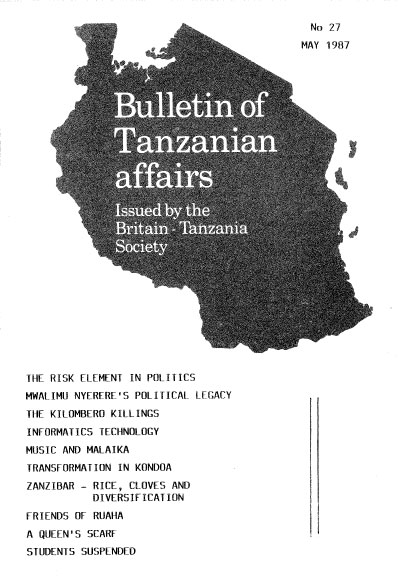
TA ISSUE 27

TA 27 cover

The Risk Element in Politics
Mwalimu Nyerere’s Political Legacy
The Kilombero Killings
Informatics Technology
Music and Malaika
Transformation in Kondoa
Zanzibar – Rice, Cloves and Diversification
Friends of Ruaha
A Queen’s Scarf
Students Suspended

MWALIMU NYERERE’S POLITICAL LEGACY

Extracts from a paper presented to the Conference on “Tanzania After Nyerere” held at the School of Oriental and African Studies, London University. A full version with a list of references is being published by Francis Pinter – Editor.

Much has been written on Tanzania’s former President, Mwalimu Julius Nyerere and his political thoughts. To the Christians and social democrats he was a liberal; to the revolutionary nationalists he was the embodiment of the African struggle for freedom and national independence; and, in the late 1960’s and early 1970’s he even won the praise of Marxists. Nyerere thus seems to be everything to everybody, A BBC Television programme once described him as an ‘Idealist in Power’ and he himself once said that he should have been preaching from the pulpit instead of being President of a Republic.

Any understanding of the transformation of Tanzania in the last 25 years must be preceded by an evaluation of its leader because Nyerere has effectively dominated the Tanzanian political scene for more than 30 years. Despite his absence from the State Presidency he will continue to be a great influence on the country for a long time to come even after he retires as CCM Chairman in 1987.

The Party
In his “Ujamaa – the Basis of African Socialism” Nyerere dismissed the idea that classes had existed in pre-colonial African societies claiming instead that these societies were living in tranquillity and peace and had seen no antagonistic contradictions. He felt that it was possible for Africans, regardless of their social backgrounds to come together in national movements and to retain unity after independence. He failed to see that the different social groups had come together during the colonial period only because each one of them was affected in some adverse way by colonialism. The nationalist movement that emerged during this time was a united front of classes and not a political party in the Marxist sense.

After the attainment of independence Nyerere insisted on the nationalist organisation retaining its old structure. He did not see the need of transforming the nationalist organisation into a political party. There were debates within TANU regarding the need, especially after 1967 when TANU had declared its intention of building socialism, to transform the organisation into a socialistic political party. Nyerere maintained throughout that TANU would remain a mass party open to every Tanzanian who believed in its objectives and principles. He completely rejected the notion of a vanguard party, saying that the structure of such a party would be like that of the Catholic Church, with a Pope, Cardinals, Bishops etc. The Tanzanian ruling party has till today remained unchanged, a mass organisation comprising people of different social classes and different ideologies. The 1982 Party National Congress voted into the National Executive Committee leading socialists and a few Marxists as well as strong anti-socialists and proponents of capitalism.

Nyerere’s theory was that the existence of a multi-party system in a young country could result in political differences which might be exploited by external powers to destabilise the country. He felt that, in the absence of powerful internal economic groups with divergent political programmes, allowing the existence of a multi-party system was a luxury that a new state could not afford. This position was easily accepted at the time because all political organisations that had existed previously had failed during the elections to gain any meaningful number of votes. Nyerere was therefore encouraged in 1963 to put forward the idea of a one-party system.

In its evolution in the last twenty years the ruling party in Tanzania has undergone several changes. The struggle between those who want the Party to continue as a united front and those who want to purify it into a revolutionary vanguard has continued. Nyerere has throughout the period taken the former stand. In 1977 when TANU on the mainland and the Afro-Shirazi Party in Zanzibar merged to form Chama Cha Mapinduzi, a compromise was struck between the two contending forces. In some of its structures, the Party moved from the British Labour party model into one found among the ruling parties of some of the socialist countries.

One of the achievements Nyerere prides himself on is the existence of a single strong party with powers supreme to any other organ of the State, including the National Assembly. But we do not know how the Party will evolve after Nyerere steps down from its chairmanship in 1987. The possibility of a multi-party system existing in Tanzania in the near future is a difficult one to predict. But what is very clear is that with the absence of Nyerere from the Party leadership the two contending forces will fight it out and whoever wins will make sure that the opposing elements are weeded out of the Party. It is the outcome of the struggle within the Party that will decide whether or not Nyerere’s progressive policies will survive in the post-Nyerere Tanzania.

National Integration
Tanzania is among the few countries in Africa that has been able to attain real national integration. The reasons given are many. It is true that over 120 ethnic groups exist in Tanzania and that there is not a single one that can claim dominance. The fact that some of the country’s leading figures such as Nyerere and Rashidi Kawawa come from small ethnic groups has also contributed to the situation. Swahili is spoken and understood throughout the country. At the time of independence there was no strong national bourgeoisie in the country and the petty bourgeois intellectuals that emerged have not been completely uprooted from their peasant backgrounds.

There were past attempts to disturb the national unity attained. In 1985 there was a strong trend in Zanzibar which almost threatened to break up the Union itself. The Zanzibaris themselves, with the help of Nyerere, were able to overcome this threat and the result was the forced resignation of the President of Zanzibar.

National integration can therefore be said to be one of the important legacies that Nyerere has bestowed on Tanzania. It is difficult to conceive of any struggle being won along tribal or religious lines. Tanzanians are highly politicised and they identify with each other, not because of common ethnic backgrounds or common religious beliefs but because they share economic or political interests.

Socialism
In 1967 Tanzania declared its intention to build socialism on the basis of self-reliance. This attracted the attention of many. To social-democrats in Europe this heralded the possibility of seeing the realisation of their ideals in an African Set-up. Imperialist powers, on the other hand, were afraid that Tanzania would set up an example to the rest of Africa. From 1967 then Tanzania’s actions in the domestic and international arenas were judged in accordance with the terms of the Arusha Declaration. Tanzania’s close relations with China or its granting of diplomatic status to the German Democratic Republic were seen as tendencies to further integrate Tanzania within the Eastern orbit. But, as Nyerere keeps reiterating, the Arusha Declaration should be viewed as a statement of intent. Neither in 1967 nor now 20 years after has Tanzania become a socialist state.

The Declaration followed discussions within the Tanzanian leadership regarding the development process that the country has been following since 1961. The Declaration should also be seen as the manifestation of a political struggle within the leadership at the time, though the document is attributed to Nyerere, who was able to capture an important movement in Tanzania’s history and to understand the feelings of his people and therefore be able to articulate their sentiments effectively. At that time in Tanzania’s leadership there was no effective and articulate socialist trend and the one person in the TANU leadership who could be said to be radical, namely Oscar Kambona, turned out later to be the very person opposed to the leadership conditions that went with the Declaration. Nyerere can therefore be said to be the intellectual power behind the Declaration.

The late Walter Rodney, in his article “Ujamaa versus Scientific Socialism” tried to present some elements of the Ujamaa philosophy as being identical with aspects of scientific socialism. One person who disagreed and who, in fact, was always at pains to disassociate the Ujamaa concept from the science of socialism, was Nyerere himself. He maintained that Ujamaa had got its roots in the African traditional society which had no classes. He completely discouraged the notion of class struggle and believed strongly that it was possible to “evolve” into socialism. In fact in many of his foreign policy statements one can see a real attempt to distance himself from a Marxist perspective.

Nyerere’s major contribution to the socialist debate in Tanzania has been in putting socialism on the agenda and in allowing different schools of socialist thought, including the Marxist one, to contend. Some of the progressive achievements of the Nyerere era are now under threat, especially with the acceptance of the IMF conditionalities but he will definitely go down in history as the person who raised the prospect of socialist development in Tanzania.

African Liberation.
Tanzania’s position on liberation is well known. Almost all the liberation movements in Africa have enjoyed sanctuary in Tanzania. Nyerere has always been non-racial in his perspective and this at times got him into conflict with his colleagues. During the days of independence he rejected the position of “Africanists” within TANU who put forward the slogan “Africa for the Africans” meaning Black Africans. This led the “Africanists” to march out of TANU and form the African National Congress. In 1958 at the TANU National Conference in Tabora when some of the leaders strongly opposed TANU’s participation in the colonially-proposed tripartite elections, where the voter had to vote for three candidates from the list of Africans, Asians and Europeans, Nyerere stood firm in recommending acceptance of the proposals.

Nyerere has always believed in peaceful means in the struggle to achieve certain political ends. When he was faced with a situation of whether to go into prison or pay a fine, he preferred the latter, not so much because he did not want to make himself a political martyr, but because, in his absence, things might have got out of hand and violence might have erupted.

However, when he is faced with a situation where all peaceful means are closed, Nyerere has never hesitated to advocate violence against an oppressive regime. A few months before Britain handed over power to the Sultan’s regime in Zanzibar he appealed to the British Government to reconsider its intention because he felt that if the situation was not rectified to allow the African majority to peacefully take power then violence was inevitable. And in this he was right, because, four weeks after independence, the Sultanate regime was violently overthrown by the opposition parties.

Given this background, one aspect of Nyerere’s position has caused some surprise. He has consistently refused to openly support democratic and socialist forces bent on overthrowing a regime in an existing African state even when it was obvious that the regime was being supported by external forces. He always invoked as his defence the OAU position of non-interference in the internal affairs of another state. Thus the opposition groups operating against Mobutu in Zaire, Ahmed Abdallah in the Comoro’s or Kenyatta, and now Moi in Kenya have enjoyed no open support from Nyerere. One hopes that as the struggle intensifies for what Nyerere calls Africa’s second liberation that this position will be discarded and that it will be possible for Tanzania to give all possible assistance to those fighting for their second liberation.

The Army
In 1961, at the time of independence, Tanganyika inherited a colonial army led by British officers. There were hardly any senior Tanganyikans. This created a problem the result of which was the army mutiny of 1964. The junior army staff demanded higher pay and Africanisation of the armed forces. What Nyerere did as a response to the mutiny was something unique in Africa at the time. He dissolved almost the entire army and created a new one. He demanded also that all those joining the armed forces must be members of the Party and introduced political education as part of army training. The result was the high politicisation of the armed forces. Tanzania was able to reap the benefit of that foresight in 1979 when it went to war against Amin’s Uganda. The army was not only motivated by the desire to recapture part of Tanzanian territory usurped by Amin, but was also committed to overthrowing him because he was perceived as a dictator and a source of tension in East Africa. It is also inconceivable that the Tanzanian army would have played any positive role in the question of African liberation had it not been for its politicisation. It is also possible that the credit for the stability that Tanzania has enjoyed during Nyerere’s Presidency is partly due to this politicised army. In his years in power Nyerere was not without his enemies. There have been conspiracies as revealed in the 1970 and 1985 treason trials. The fact that none of these succeeded supports the thesis that the army considered itself very much part of Nyerere’s regime and had nothing to gain in overthrowing him

The State
Nyerere in all his writings has failed to address himself to the State. Tanganyika at the time of independence inherited a colonial State and its institutions. What Nyerere tried to do was to give the State the national colours. But he never considered dismantling the State or how the new forces that emerged at independence could effectively use it. One can venture to say that part of the problem that has resulted in what is said to be the “failure of socialism” is the reluctance on the part of the leadership and Nyerere in particular, to examine the question of the State. It is baffling that it was thought that a colonially inherited State could be a vehicle for socialist transformation. The one person in the Tanzanian leadership who saw the problem was the late prime Minister, Edward Sokoine, who, in an address to Party cadres in 1983, conceded that the State needed to be overhauled. Unfortunately this was not taken up by the Party or the mass media.

Conclusion
Nyerere’s intellectual and other contributions have taken deep root in Tanzanian society. For the foreseeable future any Tanzanian President and Party Chairman will be judged in accordance with yardsticks set up by Nyerere. Whoever goes against the main tenets of Nyerere’s legacy is likely to not only meet with popular disapproval but to have problems with the Party. There are also certain moral principles that Nyerere laid down which leaders will long continue to be judged by. Moreover any leader pursuing tribal or religious bigotry would find it difficult to sustain his position. Even when, the liberation of South Africa from apartheid is attained it will be difficult to see post-Nyerere Tanzania giving up the struggle for total liberation and real socialism.

Haroub Othman

AID ALLOCATIONS FOR KENYA AND TANZANIA

Mr Christopher Patten, Britain’s new Minister for Overseas Development announced, during his March 1987 visits to the two countries, new British aid grants of £50 million to both Kenya and Tanzania. £25 million of Tanzania’s allocation had been announced earlier during the IMF negotiations. During the last five years Tanzania received £144.93 million in aid (£30m in 1981, £27m in 1982, £39m in 1983, £30m in 1984 and £17m in 1985). Kenya has received over £200 million during the last six years and has been the largest recipient of British aid in sub-Saharan Africa.

£12 million of the new aid for Tanzania is to be for expenditure over the next few years on development projects to be agreed between the Tanzanian and British Governments. £5 to £6 million will be for the railways and the remainder will be additional programme aid, subject to Tanzania maintaining its agreement with the IMF on the programme of economic reforms.

THE KILOMBERO KILLINGS

The Tanzanian Government has taken several measures as a result of the recommendations of the Presidential Commission investigating the killing of four sugar cane workers last year at Kilombero. Details of the incident were given in Bulletin No 26.

The Ministry of Agriculture has completely restructured the management, created a new post of Deputy General Manager and transferred a number of senior officials of the Kilombero Sugar Company.

The Morogoro Regional Crimes Officer has been sacked for his mishandling of the incident, the Morogoro Regional Commissioner has been moved to Kigoma and the Regional Police Commander has been recalled to Police Headquarters in Dar es Salaam. The Ministry of Agriculture has also directed the Holding Company, the Sugar Development Corporation (SUDECO) to extend a Shs 10 million loan to the sugar company to finance improved housing for sugar cane cutters.

President Mwinyi has also asked the Party to examine weaknesses in the Sugar Company’s CCM and JUWATA (Trade Union) branches.

Prime Minister Warioba told the National Assembly during its January session in Dodoma that the Government had received and endorsed the Kilombero probe report. He said that the leader of the police team had taken cover in the vehicle he was in as strikers threw stones at them. This left the rest of the group disorganised and they started firing randomly in the air without proper instructions from their leader.

The probe team, under the chairmanship of Judge Chipeta had said that the CCM and JUWATA branches at the factory knew nothing about the worker’s complaints. JUWATA from national to branch levels had not understood and scrutinised the workers complaints. The probe team had also recommended that the Kilombero administration should observe Presidential Directive No 1 of 1970 regarding workers education and participation.

Prime Minister Joseph Warioba said that the police had committed a big mistake and that the incident had embarrassed the Government.