REVIEWS

by Martin Walsh

SEA LEVEL: A PORTRAIT OF ZANZIBAR. Sarah Markes. Mkuki na Nyota, Dar es Salaam, 2020. 144 pp. (paperback). ISBN 978-9987-084-19-7. £27.00.
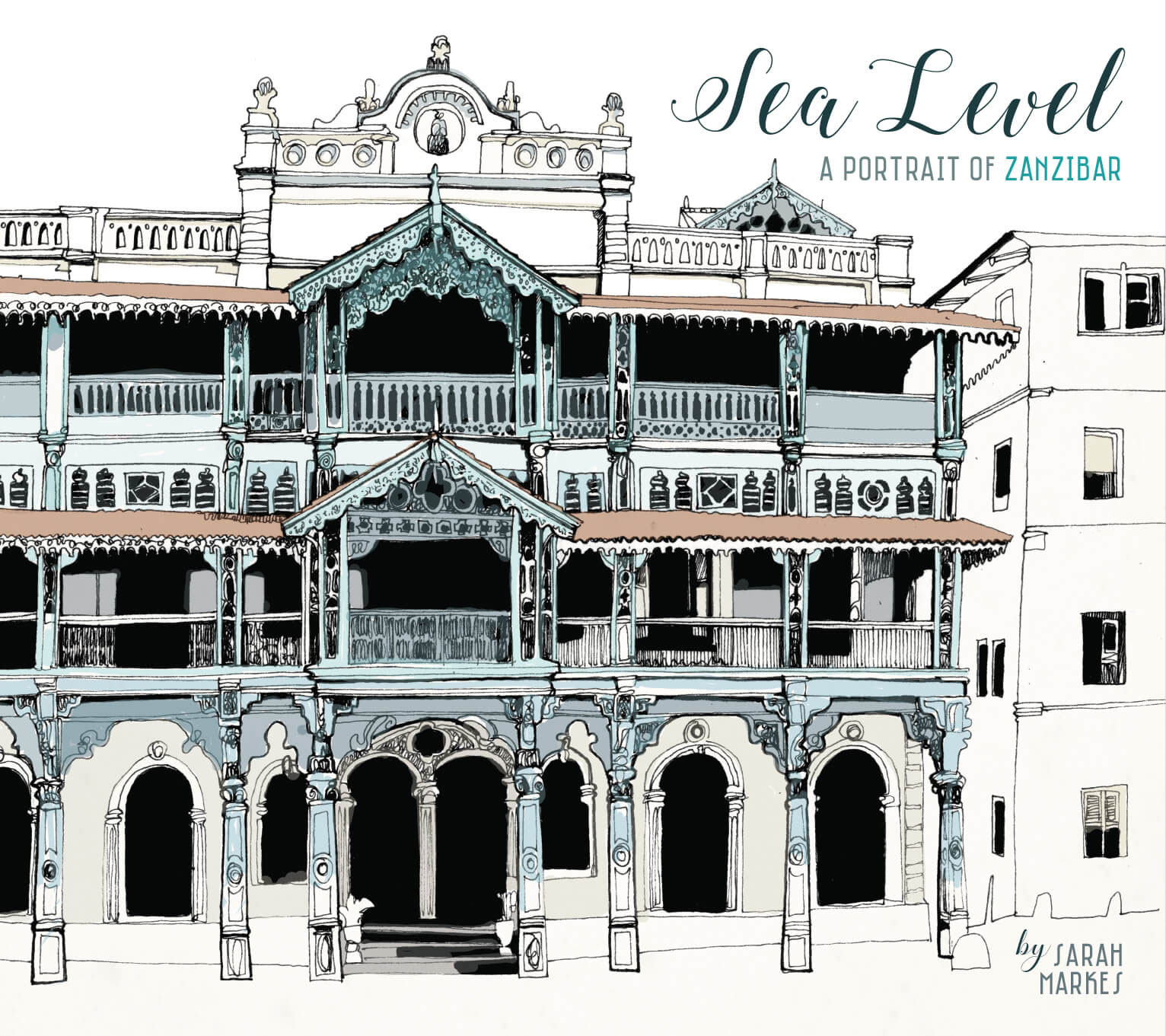
Sea Level book cover


I was very happy to be asked to review Sea Level: A Portrait of Zanzibar, as I had already seen wonderful glimpses of Sarah Markes’s work on Instagram, including the cover with its illustration of the iconic Old Dispensary on the seafront in Stone Town, Zanzibar. I lived and worked in Stone Town in the 1990s and saw the Old Dispensary being painstakingly brought back to life and splendour during its restoration by the Aga Khan Trust for Culture after years of neglect. The Old Dispensary is an example of how a building can be saved but it also illustrates the richness and multi-cultural nature of Zanzibari architecture. It seems a very fitting choice for the cover of a book which has the message of conservation at its very heart.

Sea Level follows on from Street Level, an illustrated book on the cultural and architectural heritage of Dar es Salaam, where Sarah Markes recorded the vanishing city centre with snapshots of daily life there. Both an artist and designer, the author has worked widely in East and Southern Africa on awareness campaigns, educational and environmental issues. She documents the cultural and natural heritage of places through her art and in doing so, hopes not only to raise awareness of their value but also to promote the need for their conservation. She says:

“My main aim in creating this book was to celebrate and record glimpses of this unique and beautiful place, and thus help inspire interest in its preservation.”

The illustrations in Sea Level are structured around the eight wards of Stone Town. The featured buildings are numbered so that a visitor can explore the streets visiting the various points of interest, which are linked to a GPS position. I immediately wanted to set off on a walk following the routes through the different areas. From the iconic waterfront view of old palaces and mansions at Mizingani, the Art Deco cinemas to the bustling markets and caravanserai – all the buildings have a story to tell. There are beautiful detailed line drawings but the author also uses shadow layering of photographs offering hints and echoes. The streets are alive with people too, going about their business in the town, shopping, a kofia seller scrolling on his phone, the hubbub of the dhow harbour, men playing bao. There is movement and vibrancy here – nothing is static. Small photographs are also used to zoom in on particular details, cleverly highlighting a point or focusing on a particular theme – the latticework on a balcony or detail on a carved door.

We hear about the history of Stone Town from its original settlement of mud and wattle houses to the stone buildings that followed Seyyid Said’s establishment of his capital there. The five main architectural traditions are highlighted with the layers of history and settlement of different people. There are cultural details too with the kangas and textiles, the feral cats, the spices and street seats. The details are incredibly rich and layered and I loved the illustrations of the various street light covers from saucepans to bucket lids and hub-caps. There is also a section on the natural heritage of the island, the importance of the forests and the reefs and the threats they face.

This all gives us a feeling of the mood, the vibrancy and the colour of life in Zanzibar. The smells and sounds of the place leap off each page. We are aware of the history, the monsoon winds, the people and trade and different religions that all combined to make the island so unique. Sea Level transports you there with the smell of the cloves and the taste of the freshly squeezed sugarcane juice. It also gives hope for the future with a list of organisations and NGOs who are working to help communities through education, heritage conservation and sustainable development.

In her preface, Sarah Markes explains how she was inspired by the work of the late John da Silva, a historian and watercolour artist who was also a passionate advocate of the need to protect and preserve Stone Town. I knew John well and feel sure that he would be happy to see how well Sarah is continuing his work. Sea Level captures the vibrancy, cultural diversity and uniqueness of Zanzibar. Sarah Markes writes of her hope of fostering interest in the preservation of Stone Town and initiating a gathering and sharing of stories which will be an important record of life there. Every rainy season more and more of Zanzibar’s unique old buildings are lost after years without maintenance or concern for their preservation. The partial collapse of the House of Wonders on 25 December 2020 shows that even the most iconic of buildings is under threat. Sea Level is an important reminder of what can be lost and what needs to be done.

Bethan Rees Walton
Bethan Rees Walton lived in Zanzibar from 1990-1996 and is the author of Images of Zanzibar (1996) with Javed Jafferji. After returning to the UK to study an MA in Social Anthropology at SOAS, University of London, she now lives in Pembrokeshire and teaches yoga by the sea. She is currently writing a novel which is set in Zanzibar.

THE HISTORY OF KIZIBA AND ITS KINGS: A TRANSLATION OF AMAKURU GA KIZIBA NA ABAKAMA BAMU. F.X. Lwamgira (trans­lated by G.B. Kamanzi and edited by P.R. Schmidt). Mkuki na Nyota, Dar es Salaam, 2020. xxxviii + 414 pp. (paperback). ISBN 978-9987-083-68-8. £35.00.

The History of Kiziba and its Kings is a very welcome addition to the literature on the Haya people, their culture, and their history. A translation of Amakuru ga Kiziba na Abakama Bamu, a book by the Haya scholar and chief Franciscus X. Lwamgira published in 1949, this volume gives readers a fascinating account of the history of Kiziba, one of several kingdoms established by the Haya people in what is now the Kagera Region of Tanzania. A collection of painstakingly researched and assembled oral records, it tells the history of Kiziba primarily through stories of the reigns of its kings, from the foundation of the kingdom until the period shortly after the First World War.

The importance of a history told through Haya voices cannot be overstated. Those interested in the Haya people and their culture have often relied on texts produced by European or North American observers. Some of these, such as Bengt Sundkler’s Bara Bukoba (1980), are invaluable sources produced by individuals with an intimate knowledge of the Haya people, but they nevertheless represent a body of literature written by outsiders looking in. This book, by contrast, provides a platform for indigenous voices, and allows for a better sense of Haya understandings of their own history. Whilst these sorts of local histories are more common in other parts of East Africa, particularly in Uganda, this book represents a novel and exciting development in the English-language historiography of the Haya.

The History of Kiziba and its Kings provides readers with a picture of a complex society in which a dynamic, competitive political arena was tempered by a culture in which ritual and tradition played central roles. Whilst it is unavoidably a history concerned primarily with Haya elites, it nevertheless allows for an understanding of society and the region more generally. The importance of the kings’ mothers, of ritualistic drums, and of the Haya clan system, as well as the names of places and things, are just some of the many things these stories shed light on. Importantly, they also provide an account of the challenges faced by Haya society as a result of the introduction of Christianity and German colonial rule.

There is much to commend in Galasius B. Kamanzi’s translation of Lwamgira’s work. Firstly, and most obviously, he has done an impressive job of translating into English a sizeable and complex piece of scholarship from a now largely forgotten form of the Haya language. Haya dialects have changed significantly since Lwamgira first wrote his book, so those of us with an interest in Haya history are very lucky to have individuals like Kamanzi to make accessible sources of knowledge which would otherwise be closed to us.

However, perhaps more significantly, Kamanzi has also been careful not to lose the centrality of orality in Lwamgira’s history. The subtleties of oral narrative are well preserved in the English translation, with the rhythms, refrains and constructions of the epic poetry which has historically played an important role in Haya culture coming across very effectively. That these are narratives to be remembered, recited and performed is evident, and the effect is both captivating and engaging. To capture effectively oral history in a written medium is an achievement in itself; to manage it even in translation is particularly impressive. Indeed, readers of this book cannot help but reflect on the different ways of knowing and remembering that oral cultures can teach those of us who are more familiar with written forms of knowledge.

Finally, Peter R. Schmidt, the editor of this translation, deserves credit for his very informative introduction to this edition. The history of the Haya people and their kingdoms is complex and often difficult to trace with many of the sources available. A few spelling and grammatical errors aside, Schmidt does an admirable job of contextualising both this particular work and its author, and of introducing those who may be unfamiliar with the history of this region to the oral traditions which characterise it. Overall, The History of Kiziba and its Kings is a fascinating, important book which should be added to the reading list of anybody with an interest in Haya history and culture.

Nico Brice-Bennett
Nico Brice-Bennett is a PhD candidate at the University of Edinburgh, researching the history of religion and socio-political thought in Tanzania, particularly among the Chagga and Haya peoples. Nico grew up in the Kilimanjaro Region of Tanzania before moving to the UK in 2012 to study for a BA in Ancient, Medieval and Modern History at the University of Durham. Following this, he undertook an MPhil in African Studies at the University of Cambridge, before moving to Edinburgh in 2017. His research places a particular focus on oral history, as well as on the history of regionally produced Swahili-language newspapers.

THE AMPHIBIANS OF THE TANZANIAN FORESTS. Michele Menegon, John Lyakurwa and Simon Loader. A freely downloadable visual guide, Version 1.0, December 2020. 202 pp. Available online at https://www.researchgate.net/publication/350820277_Amphibians_of_the_Tanzanian_forests


This sumptuously illustrated photographic guide to the frogs and caecilians of Tanzania’s forests is a very welcome addition to the literature on the country’s amphibians and their wonderful variety. The authors’ introduction underlines just how incomplete our knowledge of this diversity is: they estimate that around half of Tanzania’s amphibians remain unknown. As for those associated with its forests,

“The book includes a total of 152 species, for 117 of them, description and name have been published in a scientific publication. Of these species 111 are Tanzanian endemics. For about 20 of these formally described species, ongoing studies suggests that more than one cryptic taxa are included under that one name. In addition, we include in this book a further 35 species which have no formal name or published scientific account but which published studies or ‘grey literature’ have demonstrated to be distinct from already known taxa.”

At the same time, many of these species, both described and undescribed, are severely threatened by deforestation and other impacts of human activity, not least of which is climate change. The authors rightly emphasise that amphibians should be treasured and protected for more than their immediate usefulness to people, however their social and economic value might be calculated. Amphibians are integral to the tangled web of life, every thread and connection of which demands our care and attention, including best efforts at conservation.

This book represents an important contribution to that undertaking, and I look forward to updated versions of the current pdf. Otherwise, it’s worth downloading for its glorious photographs alone. It’s pleasing to see that the introductory sections have also been translated into Swahili, an increasing trend in guidebooks of this kind. It’s a pity, though, that so many newly described amphibians are still being named after a privileged minority, just when calls for the decolonisation of nomenclature are beginning to be heard.

Martin Walsh
Martin Walsh is the Book Reviews Editor of Tanzanian Affairs and recently became a member of the Editorial Committee of the Journal of East African Natural History.

Also noticed:
HISTORIA YA KIZIBA NA WAFALME WAKE: Tafsiri ya Amakuru Ga Kiziba na Abakama Bamu. F.X. Lwamgira (translated by G.B. Kamanzi and edited by P.R. Schmidt). Mkuki na Nyota, Dar es Salaam, 2020. 476 pp. (paperback). ISBN 978-9987-083-69-5. £35.00.

A Swahili translation of F.X. Lwamgira’s Amakuru ga Kiziba na Abakama Bamu (1949), the English translation of which (The History of Kiziba and its Kings) is reviewed by Nico Brice-Bennett above.

Both translations are available from the African Books Collective (ABC) at www.africanbookscollective.com, as is Sarah Markes’ Sea Level: A Portrait of Zanzibar (reviewed here by Bethan Rees Walton) and the author’s earlier Street Level: A Collection of Drawings and Creative Writing Inspired by the Cultural and Architectural Heritage of Dar es Salaam (2011).

Readers may also like to peruse ABC’s current catalogue of books published in Swahili, which includes both fiction and non-fiction titles: see https://www.readafricanbooks.com/ and https://www.readafricanbooks.com/media/website_pages/catalogues/ABC_Swahili-2021_web.pdf. Recent offerings include Ali Hassan Mwinyi’s autobiography, Mzee Rukhsa: Safari ya Maisha Yangu (2020), which we hope to review in a forth­coming issue.
Martin Walsh

OBITUARIES

by Ben Taylor

Former Finance Minister, Basil Mramba died at the age of 81 on Tuesday August, 2021 at Regency Hospital in Dar es Salaam while undergoing treatment. The family said he had been admitted at the facility with Covid-19 complications.
Basil Mramba was born in May 15, 1940, and was MP for Rombo constituency in Kilimanjaro region. He served in various position in the government including Mbeya Regional Commissioner (1995-2000), Minister of Finance (2001-2005) and Minister of Trade and Industry (2006-2008).
In July 2015, Mramba alongside former energy minister Daniel Yona was sentenced to three years in jail after being convicted of 11 counts of abuse of office and causing a TSh 11.7 billion loss to the government. They were released after serving six months and ordered to do community services while serving a suspended sentence for the remaining two years of their jail term.
In his time as Finance Minister under President Mkapa, Tanzania was undertaking major economic reforms aimed at transforming the country from a state-controlled economy to a private sector-led one. He played a key role in talks with the International Monetary Fund (IMF) and World Bank that eventually saw Tanzania being granted debt relief of $3 billion, reducing the country’s total external debt by 54%, and reducing the amount to be paid as interest on the loans.

Former Presidential candidate and Kilimanjaro Regional Commissioner, Anna Mghwira, has died at the age of 62. Ms Mghwira was appointed as Kilimanjaro RC by the late President John Magufuli on June 03, 2017. Before that she had been the ACT-Wazalendo presidential candidate in the 2015 General Election.
Anna Mghwira was born in Singida. Her father was a councillor representing TANU. After attending Nyerere Primary School, Ihanja Secondary School and the Lutheran Seminary, she earned a Bachelor’s Degree in Theology from Tumaini University and a Law Degree from the University of Dar es Salaam. Her studies then took her to the UK, where she attained a Master’s Degree in Law (LLM) from the University of Essex in 2000. She then worked for various local and international organisations dealing with women’s empowerment, community development and refugees.
Her political journey started during the TANU era, when she was a member of the party’s youth league. But she reduced her participation in politics in the late 1970s to focus on her education, career and family.
She returned to active politics in 2009, joining Chadema, where she held various junior leadership positions. In March, 2015, she left Chadema for the newly formed ACT-Wazalendo, where she was later nominated the party’s national chairwoman during the party’s first general congress. Later that year she ran for President of Tanzania, representing ACT, achieving just 1% of the vote, despite attracting considerable support from the country’s intelligentsia.
Two years later she was appointed Kilimanjaro RC by President Magufuli, a role in which she served until her retirement earlier this year. Her appointment surprised both opposition supporters and many ruling party members as she was still chair of ACT-Wazalendo at the time.
President Hassan issued a statements saying that Ms Mghwira had played a great role in the country’s development.
“I am saddened by the passing of the former Kilimanjaro Regional Commissioner Anna Mghwira. I will remember her for her great contributions in the building of the country,” she said.

Sigvard von Sicard 1930-2021 was a Swedish Lutheran pastor and theologian whose special interest was in improving relationships between Christians and Muslims. In 1957 he became pastor at Maneromanga, about 50 miles South West of Dar es Salaam, beyond Kisarawe, in those days very remote and hard to get to. His wife Judith gives dramatic descriptions of what life was like in her book Beyond the Narrows: Cultural Reflections from My Missionary Life (2013).
In 1966, Sigvard joined the staff of Makumira theological college (now university) near Moshi, and in 1970 he received a PhD from Uppsala for a thesis and subsequently a book on the story of the Lutheran Church on the Coast of Tanzania, 1887-1914.
In 1971 the family moved to England, where he became a key figure in the Centre for the Study of Islam and Christian-Muslim Relations at Selly Oak Colleges in Birmingham. When this closed in 1998 he stayed on as an Associate in the Theology Department of Birmingham University where he was “the father to African students” and always made sure that those who got degrees had some kind of celebration, even if their families could not attend it.
He felt deeply about Africa and African people, and once described himself as “white on the outside and black on the inside”. He kept his interest in Tanzania, and especially Swahili and Islam, till the end.
Andrew Coulson

Minister of Defence and National Service, Elias Kwandikwa, died on August 2 while undergoing treatment in Dar es Salaam. The cause of his death was not immediately made public.
Kwandikwa, who died at the age of 55 was MP for Ushetu Constituency in Shinyanga Region. He was appointed Minister of Defence by late President John Magufuli during his second term on December 05, 2020. Prior to this he had served as Deputy Minister of Works, Transport and Communications.

TANZANIA BIDS FAREWELL TO PRESIDENT MAGUFULI

by Ben Taylor

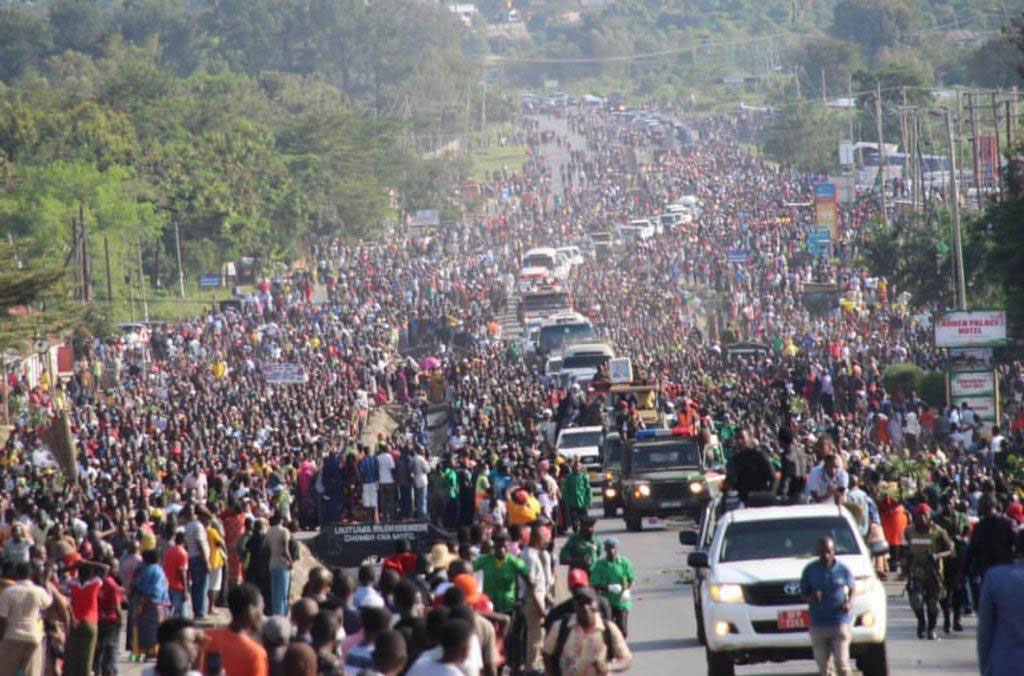
Large crowds view the funeral cortege near Mwanza.

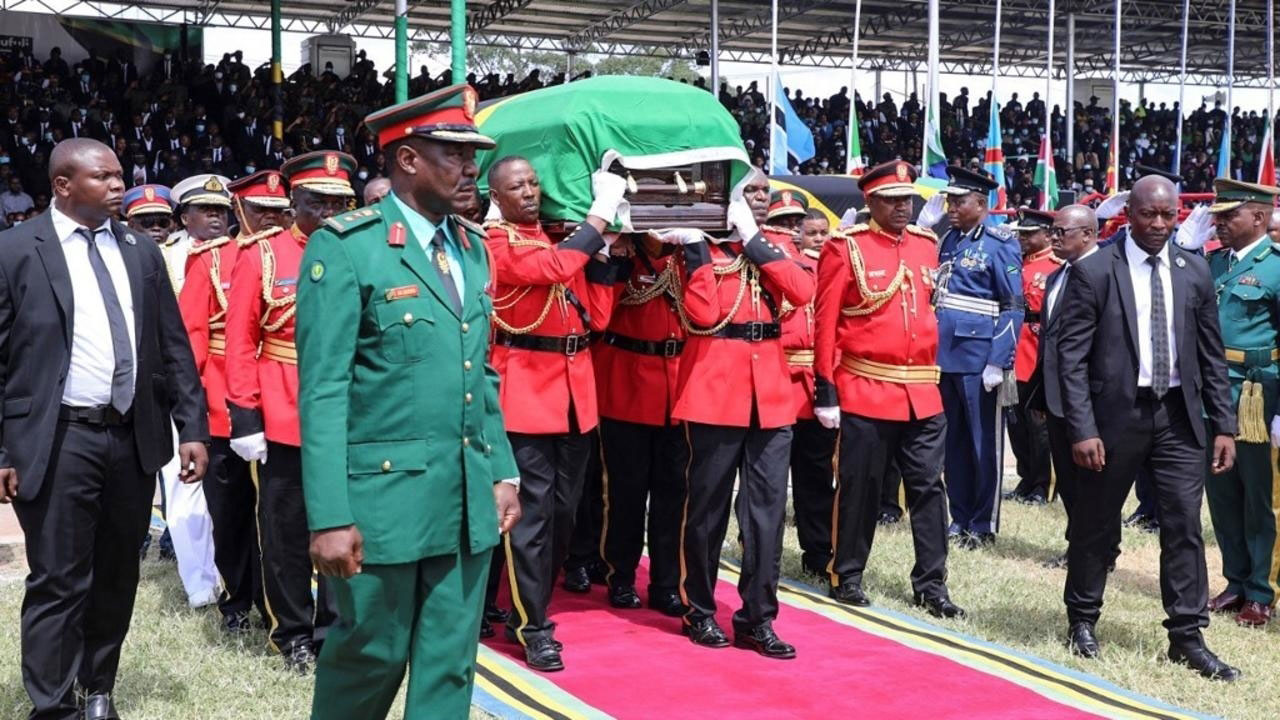
President Magufuli’s coffin is carried into the National Stadium.

President John Pombe Magufuli has died, at the age of 61. He is succeeded by his Vice President, Samia Suluhu Hassan, the country’s first female President, who was sworn in on March 19th, 2021. “This is a time to bury our differences, and be one as a nation,” she said in her inaugural address as leader.

The months of March and April 2021 were a rollercoaster ride for Tanzania. From a few days after the last public appearance of President John Pombe Magufuli on February 27th, to the first State of the Nation address to parliament of President Samia Suluhu Hassan on April 22nd, the nation was beset with a chaotic mix of rumours, tension, drama, mourning and, for some, elation. The full details of what happened during some critical episodes remain uncertain at this time, and may well continue to be disputed by historians and others for many years to come.

The most important facts are known: that President Magufuli passed away, five months into his second term in office, and that his Vice President, Samia Suluhu Hassan, is the new President of Tanzania.

The uncertainty remains in many of the details of how this took place. Rumours began circulating a week into March that President Magufuli had been taken ill. He had not been seen in public for several days, which was unusual but not unprecedented for him. These rumours extended to suggestions that he had contracted the Coronavirus and was suffering severe symptoms. It remains uncertain whether such rumours were based in truth or founded largely on the irony of the idea that a Covid-sceptic President could face such a scenario.

On March 10th, a Kenyan newspaper, The Daily Nation (part of the same media group that owns The Citizen and Mwananchi newspapers in Tanzania, and The East African) put oil on the fire of these rumours. They published an article reporting that an “African leader” was at that time admitted to Nairobi Hospital for Covid-19 treatment, stopping short of naming the leader or the country but hinting very heavily that this was President Magufuli.

Whether the President was indeed admitted to hospital in Nairobi remains uncertain. Senior figures in government, including Prime Minister Kassim Majaliwa, certainly denied this fact. The credibility of their denials is hard to judge, however, given that they also denied that the President was unwell. The Prime Minister asked Tanzanians to be calm because “President John Magufuli is safe and he is going about his work,” and accused “hateful Tanzanians living abroad” of spreading rumours. “If he were sick,” he asked, “would I have spoken to him on the telephone? He sent his greetings to you.”

Beyond reporting such reassurances, Tanzanian media stayed almost entirely silent on the health and whereabouts of President Magufuli at this time. In contrast, international media outlets – the BBC, Al Jazeera, Reuters, and many more – covered the matter eagerly, quoting unnamed sources and reporting every utterance of opposition leader, Tundu Lissu, as he made a series of bold and largely evidence-free assertions about the situation. The President had already died, according to some rumours, or had been transferred to a hospital in India, or South Africa. The President’s closest allies were alleged to be taking advantage of the power vacuum to loot the national gold reserves and/or the Bank of Tanzania.

The audience for international media houses within Tanzania may be small, but rumours spread rapidly, particularly on WhatsApp and similar services.

On March 15th, Vice President Samia Suluhu Hassan urged Tanzanians not to be unnerved by “rumours flying around”, saying “the country was safe”. “It’s quite normal for a person’s body to be indisposed and contract the flu or develop a fever… this is the time for Tanzanians to be united through prayer,” she said, without stating who she was talking about. “As Tanzanians, we must work together, be united and build our nation. Most of the rumours you hear don’t originate in Tanzania, they come from outside the country. I ask you to ignore them. If it’s about prayers, pray, but all in all, we should remain united and take Tanzania forward. We’re safe,” she said.

On the same day, The Citizen newspaper reported that police across the country had continued “crackdowns on those spreading false information, especially on social media platforms.” They noted reports that police in Kilimanjaro region were holding two people on suspicion of spreading false information on social media concerning senior government officials’ health. “This brings the number of suspects arrested in connection with spreading online fabricated information related to the health of President John Magufuli to four,” the paper stated.

Two days later, on March 17th, the Vice President made a short statement live on the state-run TBC TV station. Visibly distressed, she announced that President Magufuli had died at 6pm that evening at Mzena hospital in Dar es Salaam. He had been admitted, she stated, on March 6th to the Jakaya Kikwete Heart Institute after suffering complications related to his long-standing heart condition, chronic atrial fibrillation, but had been released the following day. A week later, on March 14th, he had felt unwell and was admitted to Mzena hospital, where he remained until his death three days later.

Reactions: grief, tributes, and a few celebrations
Vice President Hassan announced fourteen days of national mourning. Huge crowds of mourners lined the streets and flocked to see his body lying in state in the cities of Dar es Salaam, Dodoma, Zanzibar, Mwanza and Geita, weeping and throwing petals as it passed in a motorcade.

In one tragic case, 45 mourners were killed and 37 injured due to stampedes and lack of air amid overcrowding at a public viewing of the body at Uhuru stadium in Dar es Salaam, on March 21st. This was confirmed by Lazaro Mambosasa, Dar es Salaam’s zonal police commander. The stampede was triggered when a wall collapsed after some people climbed it to get a better view, according to Mr Mambosasa.

President Magufuli was buried in the evening of March 26th at his home in Chato, in northwest Tanzania. His body arrived at Rubambagwe Stadium, Chato, mid-morning, and he was honoured with the singing of the national anthem and East African anthem, and a 21-gun salute. A Catholic mass was conducted by the Archbishop Gervas John Nyaisonga, and his body was transferred to his home for burial. President Samia Suluhu Hassan, ex-presidents Ali Hassan Mwinyi and Jakaya Kikwete, other dignitaries and religious leaders from different faiths were in attendance.

It is hard to assess the true level of President Magufuli’s popularity with Tanzanians, as the usual measures were all compromised. The general election in 2020, in which he won 84% of the vote, was marred by irregularities, and opinion polling had been suspended – effectively banned – since a poll published in 2018 suggested his popularity had fallen sharply from previous record highs. And yet there is no doubt that among many, probably most Tanzanians, President Magufuli was a hero: for speaking for ordinary citizens, for standing up to foreign business interests and governments, for rooting out corruption and waste, and for investing in the country’s future.

“I have never cried because of any leader’s death, but President Magufuli has made me cry because I remember his good performance,” said Lucky Mwandeko, a resident of Dar es Salaam. “He brought discipline to the country. We have lost a very great leader.”

Equally, there are some who saw President Magufuli as a villain: that his stance on the Coronavirus pandemic had cost lives, that he showed little respect for the rule of law or freedom of expression, that his hardball tactics with investors undermined the country’s economy, that his misogyny turned back the clock on the cause of gender equality, that he subjected his political opponents to imprisonment and violence, that he systematically weakened democracy and democratic institutions.

Among Tanzanians, the foremost such voice belongs to the opposition leader Tundu Lissu. Speaking from exile in Belgium, he described President Magufuli’s death as “poetic justice,” alleging that he succumbed to COVID-19 after defying the world and science on the virus. “Magufuli caused havoc to our country,” he said. “There are so many people who have been killed in these five years, … injured, tortured, persecuted. I barely escaped with my life. He is dead and this is an opportunity, a rare opportunity, for our country to come together for national reconciliation,” he said.

International media obsessed over the thought that a Covid-denier might have succumbed to Covid. “Bulldozed by reality,” was the headline in The Economist.

A more nuanced view came from political columnist Elsie Eyakuze, no fan of the late President. “Dear John, I forgive you,” she wrote. “Death has robbed us of the leader you might have become if our prayers had been answered.”

“I can admit that I thought news of your demise would delight me. … It turns out I was wrong. My relief that your misogyny and cruelty will no longer weigh upon my mind is real and will remain with me forever. But I did not expect to feel sad. I did not expect to feel a bit bereft, slightly melancholy. I certainly did not expect to be moved when I watched your casket being opened for public viewing as your friends and family, who clearly cared for you, shed tears. I did not expect to attend mass via television not once, but twice, and genuinely pray that your Lord would have mercy on your soul.”

“Cause of death? Frankly, my dear, I don’t give a damn. I do care that you did not die alone. John, I truly hope that someone held your hand with comfort and tenderness to the very end, that you were not afraid, that you were not in pain. Foolish, weak-hearted, stupid woman that I am, I hope you passed on peacefully.”

INTRODUCING PRESIDENT SAMIA SULUHU HASSAN

Ben Taylor

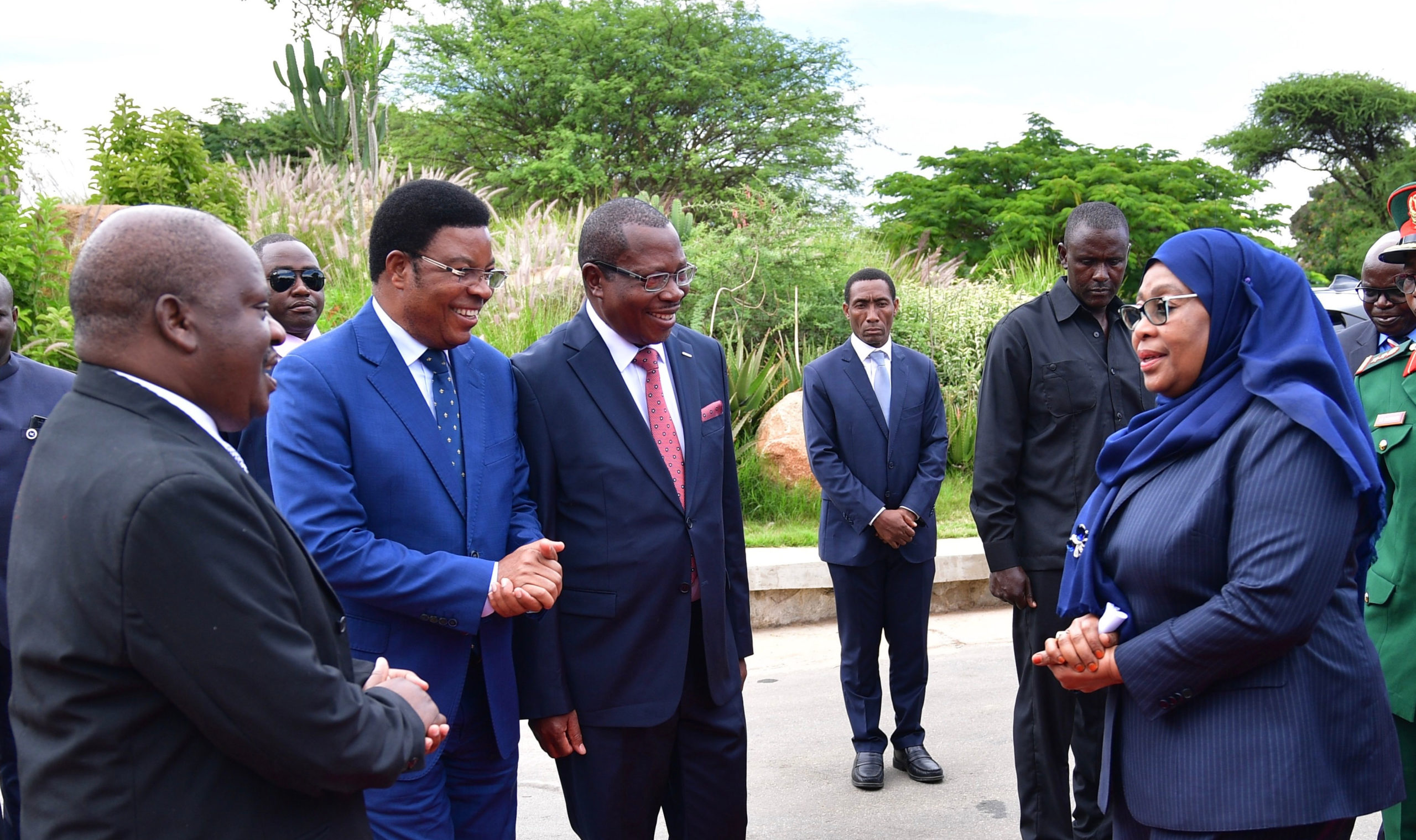
Left to Right – Speaker Job Ndugai, Prime Minister Kassim Majaliwa, Vice President Dr. Philip Mpango and President Samia Suluhu Hassan (Ikulu).

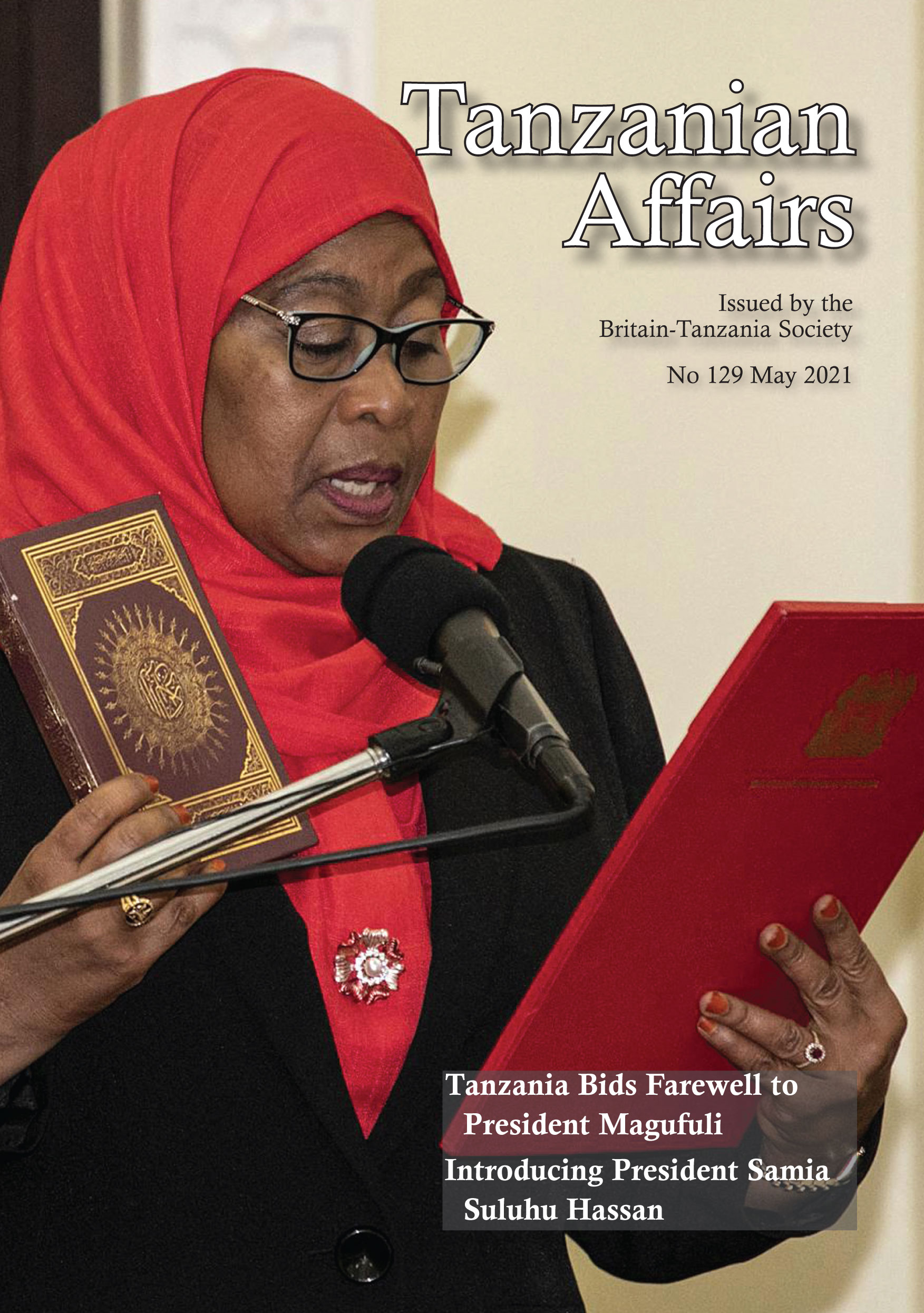
President Samia Suluhu Hassan was sworn into office as President on March 19th, 2021. She becomes Tanzania’s sixth President and the country’s first female President. She will serve the remainder of President Magufuli’s second term to 2025, and under the Constitution will be eligible to run for one further five-year term.

“Today I have taken an oath different from the rest that I have taken in my career,” she said. “Those were taken in happiness. Today I took the highest oath of office in mourning.”

The symbolism of having a female, hijab-wearing head of state was widely noted at the time of her swearing-in, with observers noting also the prominent all-female front line of military band drummers that danced their way through the parade, and spotting that the aide-de­camp standing close throughout the process was also a woman.

President Hassan is also the country’s first president born in Zanzibar – in Makunduchi, in January 1960. (President Mwinyi was also Zanzibari, but born on the mainland.) She completed her secondary education in 1977 and began her career as a clerk at Zanzibar’s Ministry of Planning and Development. The following year she married Hafidh Ameir, an agricultural officer, now retired, with whom she has four children. She pursued a number of short-courses on a part-time basis, before graduating in 1986 from the Institute of Development Management (present-day Mzumbe University) with an advanced diploma in public administration. Between 1992 and 1994, she attended the University of Manchester, UK, and earned a postgraduate diploma in economics, and in 2015, she obtained an MSc in Community Economic Development via a joint-programme between the Open University of Tanzania and the Southern New Hampshire University.

After spells with the World Food Programme and Action Aid, she turned to politics in 2000. She was elected as a special seats member of the Zanzibar House of Representatives and was appointed a minister by President Amani Karume, the only high-ranking woman minister in the cabinet. In 2010, she sought election to parliament, winning the Makunduchi seat comfortably. President Kikwete appointed her as Minister of State for Union Affairs, and in 2014, she served as Vice Chair of the Constituent Assembly tasked with drafting the country’s new constitution.

President Hassan takes office without her political views and personality having previous been widely known. Before her selection as the CCM vice-presidential candidate in 2015 she had been a relatively obscure figure on the national political stage, and as Vice President she had largely aligned herself behind the President, though she showed an independent streak in choosing to visit opposition leader Tundu Lissu in hospital after an assassination attempt, against the President’s wishes.

January Makamba – himself a former (and likely future) presidential aspirant – described her as “the most underrated politician in the country”. And since taking office, she has demonstrated considerable dynamism and skill in negotiating a potentially difficult transition. In a series of speeches, appointments and pronouncements, she managed both to reassure supporters of the former President that she would continue to follow the path he laid down and to indicate to his critics that her approach would be different in significant ways.

In several closely watches speeches shortly after taking office she gave a sense of her direction as President, taking actions and laying out a long list of pledges and priorities. In combination, these speeches signalled three major changes of direction compared to her predecessor.

First, and most prominently, she showed her intention to improve the environment for business and foreign investment. She directed the Tanzania Revenue Authority (TRA) to stop frustrating businesses by milking them dry and instead look for new ways on how to expand the tax base. “Using a lot of force in collection of tax, closing taxpayers’ bank accounts, forcefully taking money from their accounts, just because the law allows you to do so, is unacceptable,” she stated. For similar reasons, she directed the immigration authorities to stop frustrating investors by limiting number of non-Tanzanian staff. And she directed Ministers find a lasting solution to the bureaucracy on tax matters that was frustrating investors, saying it was disheartening that VAT refunds were not being made as required. (See also Economics section in this issue.)

Second, she signalled a more open and pro-democratic approach to politics. She directed the Information Ministry to lift bans imposed on some media outlets, and announced her intention to meet with opposition leaders to resolve disagreements about the political environment. She directed the corruption watchdog (PCCB) to concentrate on its key responsibilities and to drop “baseless” cases – interpreted by some as code for “politically motivated cases”.

Third, she announced the formation of a committee of scientists to assess the state of the Coronavirus pandemic in Tanzania and propose a way forward. This could be a move to prepare the ground for a change in the government’s response to the pandemic, though it should be noted that the committee is yet to report and the President is yet to introduce substantive reform in this area. (See also article on the pandemic, in this issue.)

In terms of appointments, President Hassan nominated respected Finance Minister, Philip Mpango as the new Vice President. His nomination was unanimously endorsed by MPs. Other changes include the nomination of Liberata Mulamula as an MP and as Foreign Minister, replacing Prof Palamagamba Kabudi who now takes over as Minister of Justice and Constitutional Affairs. Mwigulu Nchemba, the former Minister for Justice and Constitutional Affairs now becomes the Minister of Finance and Planning. Ummy Mwalimu becomes the Minister in the President’s Office for Regional Administration and Local Government, swapping roles with Jafo Selemani who now serves as Minister of State in the Vice President’s Office.

Most strikingly, the former CCM General Secretary and close ally of President Magufuli, Bashiru Ally, has been removed as Chief Secretary just one month after his appointment. His position is taken by Tanzania’s Ambassador to Japan, Hussein Athuman Katanga.

For sad and unexpected reasons, Tanzania’s institutions of government were tested in this period, but came through, completing another peaceful, constitutional transfer of power. The next test is for the new President. She has a weak base in the party and a divided nation, but after just a few weeks in office she has already shown signs of a deft political touch. We wish her the best.

What’s in a name? President Samia, President Hassan, or Mama?
As yet, no clear consensus has emerged on what name to use for the new President. Most Tanzanian newspapers refer to her as “President Samia” or “Rais Samia”. Some have also used “President Hassan,” which has been the most common choice of international media. Previously, both as Vice President and before, she was generally known as “Samia Suluhu”.

Some in Tanzania have adopted “Mama”, or “Mama Samia”, though this has also drawn criticism for disrespecting the new President, and/or fostering a maternal image that may or may not prove to be appropriate.

Standard naming practice in Zanzibar is personal name + father’s personal name + grandfather’s personal name. This is not adhered to by all, however, as many in practice use just the first two parts – hence Samia Suluhu. And some with well-known fathers may choose to use the third part of their father’s name as the third part of their own: so (former President) Ali Hassan Mwinyi’s son, the current President of Zanzibar, retains “Mwinyi” and becomes President Hussein Ali Mwinyi (rather than Hussein Ali Hassan).

Here in Tanzanian Affairs, we will follow the lead shown by the President’s Office, which is referring to the new president as either President Hassan, or President Samia Suluhu Hassan. We will do likewise unless and until it becomes clear that a different form of her name becomes the consensus choice.

CORONAVIRUS UPDATE

by Ben Taylor

January to March 2021

The early months of 2021 saw rising alarm in Tanzania over a possible new wave of Coronavirus infection, with anecdotal evidence from hospitals and other sources across the country suggesting a rise in case numbers. Nevertheless, throughout January the government continued to insist that the country had defeated the pandemic. No new data on case numbers or fatalities was reported (as has been the case now for over 12 months).

And more significantly, the government signalled that it had no intention of participating in COVAX, the international effort to supply Coronavirus vaccines to developing countries. On February 1st, the Minister of Health, Social Development, Gender, Elderly and Children, Dr Dorothy Gwajima, said the government had no plans of procuring the Covid -19 vaccine which is already in use in other countries, and Tanzania was conspicuous by its absence from the initial COVAX distribution list, published on February 3rd. It was (and remains) unclear whether the country would even license the vaccines, which would allow private hospitals to import the vaccine and individual citizens to get vaccinated.

“The ministry has its own procedure on how to receive any medicines and we do so after we have satisfied ourselves with the product,” said the Minister. This came a week after President Magufuli warned the ministry of the danger of foreign vaccines, doubting their effectiveness and saying they came with ulterior motives.

Instead, the ministry encouraged people to take other precautions against “viral infections”, without specifically mentioning Covid-19: “We must improve our personal hygiene, wash hands with running water and soap, use handkerchiefs, herbal steam, exercise, eat nutritious food, drink plenty of water, and natural remedies that our nation is endowed with because we have quite many of these natural remedies, ”said Dr Gwajima. “Through the Chief Government Chemist, the Ministry has been working to inspect a number of natural remedies that have met the safety standards for use, are already in use and they have helped Tanzanians, including me and my family.”

A few weeks into February, however, there were signs that the government was edging towards an acceptance that the virus was still present and causing serious problems, perhaps pressed to do so by the growing weight of evidence.

The illness of the Vice President of Zanzibar, Maalim Seif Sharif Hamad, who was admitted to hospital with respiratory problems on January 31st after testing positive for Covid-19, and passed away on February 17th (see obituaries section), made the true situation harder to deny. On February 11th, an MP from the ruling CCM party, Zacharia Isaay, spoke in parliament to express concerns at the alarming number of “pneumonia” patients in his constituency – concerns that were echoed by other MPs.

Around the same time, several other prominent figures passed away, all with symptoms consistent with the Coronavirus. This includes Prof. Benno Ndulu, former Governor of the Bank of Tanzania, and the Chief Secretary, Amb. John Kijazi (see obituaries section). Tanzania Episcopal Conference (the Roman Catholic church in Tanzania) reported that more than 25 priests, 60 sisters and two elders of the laity had died within the past two months of various causes including respiratory challenges.

On February 20th, amid claims of a worrying rise in cases and deaths attributable to the pandemic, the government announced measures to contain the spread of the virus. In contrast to its previous stance, the government now asked Tanzanians to adopt preventive measures: prayer, handwashing, sanitisers, face masks, physical exercise, shielding for the vulnerable, improved diets and traditional remedies, but no lockdown measures.

The same day, President John Magufuli told worshipers at the Roman Catholic St Peter’s Parish in Dar es Salaam that Tanzanians should take precautions against the Coronavirus. He stated that the government hasn’t prohibited the use of face masks in the war against Covid-19, but stressed however that locally made masks – especially those from the Medical Stores Department (MSD) – should be used rather than imported masks. And he advised people to adopt traditional methods of containing respiratory diseases, including steam treatment, and to avoid fear which can itself have negative impacts. He reiterated that Tanzanians must continue to put their trust in God.

Also on the same day, the Director General of the World Health Organization (WHO), Tedros Adhanom Ghebreyesus, called upon Tanzania to take “robust action” to combat Covid-19. He noted that a number of Tanzanians travelling to neighbouring countries and beyond have tested positive for the coronavirus. “This underscores the need for Tanzania to take robust action both to safeguard their own people and protect the population beyond,” he said. “This situation remains very concerning. I renew my call for Tanzania to start reporting Covid-19 cases and share data.”

Two days later, on February 23rd, Minister Finance and Planning, Dr Philip Mpango, held a dramatic press conference from a lobby area within Benjamin William Mkapa Hospital in Dodoma, where he himself had been receiving treatment. Clearly exhausted, and coughing and crying as his spoke, he praised the hospital and its doctors for keeping him alive, and President Magufuli for his support. He spoke of having needed oxygen, but did not mention the Coronavirus by name.

By mid-March, however, events took a different turn. The possibility of President Magufuli changing course began to be overshadowed by the fact that he had not been seen in public since February 27th. Rumours around his own health began to grow.

Coronavirus update – April 2021
On April 6, President Samia Suluhu Hassan (see main article) announced what could be the start of an attempt to change the government’s stance on the pandemic. She stated her intention to form a committee of experts to professionally assess the state of the Covid-19 pandemic and advise the government on the way forward.

“We cannot isolate ourselves as if we are an island, but also we cannot accept everything brought to us. We cannot continue just reading about Covid-19 worldwide, but Tanzania is all blank – it makes no sense.”
Two weeks later, the President spoke at a national conference organised by religious leaders to remember ex-President John Magufuli and pray for the new leaders. She called on religious leaders to advise worshippers to take precautionary measures against the virus, and also reported that the committee of experts had been formed.

“I’m expecting to meet its members and representatives of the Ministry of Health and those from the Ministry of Finance and Planning in the near future in order to establish the way forward,” she said.

At the time of writing (April 27), the committee is yet to report, and no substantive change of policy has been introduced. There has been no new release of data on testing, for example, and no change in the country’s position regarding vaccines.

BUSINESS & THE ECONOMY

by Ben Taylor

A Samia Stimulus
Among the many announcements and shifts in direction brought in by the new President, Samia Suluhu Hassan, is a new focus on encouraging investment and stimulating economic growth. She signalled this first when speaking at the swearing-in ceremony for new permanent secretaries on April 6 and then again in her first State of the Nation address to parliament on April 22.

“We intend to focus more on economic growth,” she told MPs. “We will continue the good work achieved during the previous administrations, change where necessary but with a view to promoting efficiency and productivity, guided by the national, regional and party manifestos.”

“Last year, our nation managed to enter the middle-income category where the per capita income increased to $1,080 from $1,036. It is a great achievement, but more effort is needed to accelerate the economy,” she added.

Framed as a package of measures to strengthen the country’s economic recovery from the effects of the global Coronavirus pandemic, the President spoke at length on the need to regain investor confidence. She noted that investors have been complaining about Tanzania’s unpredictable investment climate, hostile tax collection tactics and bureaucracy, saying the situation would change with her at the helm as Tanzania’s sixth president.

“The government will be taking specific steps to promote investment by looking into investment policies, laws, and regulations, remove clauses that are hampering smooth investments, including unpredictable policies, an unstable tax system and unnecessary bureaucracies,” she explained.
“The sixth phase government will take an uncompromising approach on this, and we will start with the blueprint (for the improvement of Tanzania’s business climate, which was approved in 2018). Issuance of permits and licences will be streamlined, and so will the process of issuance of land to investors.”

Under her administration, President Hassan said, the tax collection would focus on compliance instead coercion and intimidation. In partnership with the Tanzania Private Sector Foundation (TPSF), the government plans to put in place a system through which members of the private sector can forward their complaints directly to the government.

She added that the government will strengthen the Foreign Affairs ministry to drive investment. “Economic diplomacy will be our emphasis,” she stressed, saying the country’s relations with the outside world would now hinge on economic partnerships.

World Bank assesses the economic impact of the Coronavirus in Tanzania
Tanzania’s economy has fared relatively well under the Coronavirus pandemic, but still registered its first decline in per capita GDP for over 25 years, according to the latest Tanzania Economic Update, published by the World Bank in February 2021.

Titled “Raising the Bar: Achieving Tanzania’s Development Vision”, the report noted that Tanzania’s economy had suffered much less than its neighbours under the pandemic, but that it had still suffered. “The real GDP growth rate fell from 5.8% in 2019 to an estimated 2.0% in 2020, and … the global economic slowdown has adversely affected export-oriented industries, especially tourism and traditional exports, and caused a drop in foreign investment.”

A survey of 1,000 small and medium enterprises in Tanzania in June and July 2010 found that an estimated 140,000 formal jobs were lost and another 2.2 million non-farm informal workers suffered income losses. “Tanzanians employed in informal non-farm microenterprises tend to be especially exposed to economic shocks, as they often have limited savings to draw on in a crisis,” said the report. “Firms reported an average decline in sales of 36%, which has jeopardized the solvency of more than three-quarters of small and medium enterprises. Most affected firms have not benefited from any type of government support.”

“Although the government did not impose stringent mobility restrictions, the pandemic prompted firms and consumers to adopt precautionary behaviour, hindering domestic economic activity. Meanwhile, steep declines in production, consumption, and imports have significantly reduced fiscal revenue.” The result, according to the report, is that an additional 600,000 people could fall below the poverty line.

The report’s authors cautioned that the future of both the pandemic and the national economy remain highly uncertain. In particular, they noted that without quality information on the state of the outbreak in Tanzania, it remains difficult to plan and implement effective policies, both in terms of public health and managing the economy.

The report also warned that the country’s much-cherished attainment of lower middle income status (LMIS, officially achieved in July 2020) could be fragile. “Over the past 10 years, 23 countries have fallen from middle- to low-income status or from high- to middle-income status. … As the COVID-19 pandemic continues to depress global economic activity, Tanzania will need to endure an indefinite slump in external demand regardless of the effectiveness of its domestic health response.”

This fragility is also linked to the country’s unusual combination of middle-income status with persistent high levels of poverty. For countries newly achieving LMIS, the average poverty rate based on the international extreme poverty line is 30%, while Tanzania’s extreme poverty rate remains close to 50% percent. “Rapid population growth, slow and uneven job creation, low levels of education, and limited access to educational and employment opportunities, especially among women and girls, have reduced the inclusiveness of Tanzania’s economic expansion, blunting its effect on poverty reduction,” argues the report.

2021-22 Budget
The total value of the national government budget for 2021-22 will be TSh
36.23 trillion (USD $14bn), according to the budget framework present by Finance and Planning Minister, Dr Phillip Mpango to parliament on March 11. This represents an increase of 3.9% (TSh 1.35tn) over the 2020­21 budget, slower than the increase in previous years, and comparable to both the World Bank’s latest estimate of the rate of GDP growth (4.5% in 2021) and to the rate of inflation (3.7%).

Of this amount, TSh 26 trillion will be sourced locally, including TSh 22 trillion raised by the Tanzania Revenue Authority (TRA). Development partners will provide TSh 2.9 trillion in grants and concessional loans, representing 8% of the total. The government will source another TSh
7.3 trillion in form of domestic and foreign loans.

“It is the government’s view that implementation of the 2021/22 development plan and budget will stimulate economic growth, improve delivery of social services, create job opportunities as well as development for people and the nation at large,” said the minister.

The government, according to Dr Mpango, will focus much of the development budget on executing the ongoing priority projects before embarking on new ones. This includes the Julius Nyerere Hydropower Station (TSh 1.3 trillion), currently under construction at Stiegler’s Gorge on the Rufiji River, ongoing construction of the Standard Gauge Railway (TSh 3.2 trillion), and construction of passenger terminals and the purchase of aircraft for Air Tanzania (TSh 1.5 trillion).

TOURISM & ENVIRONMENTAL CONSERVATION

by Paul Harrison

Red lights remain. Shifting to green from June?
Like so many countries, Tanzania continued to suffer the impacts of the global near-standstill of tourism traffic in the first quarter of 2021, as tourists from traditional markets were unable to travel due to second and third waves of COVID and resultant lockdowns. Tanzanian tourism operators have forecasted contractions in tourism of over 80%, according to a World Bank economic update on the country. An uncertain stance on the pandemic and fear of variants has led to Tanzania’s inclusion on red lists and travel warnings. However, as many countries progress vaccination programmes and the northern hemisphere summer approaches, the Tanzanian tourism industry has high expectations for a boost in numbers from June 2021. Many hotels and camps are already fully booked for the forthcoming high season; however tour operators are also experiencing last minute cancellations or delayed arrivals as pandemic-related restrictions change plans.

Red lists, regulations and repeat business
Despite rising bookings, the expected boost is not without risk. Whilst (at the time of publication) countries like the UK continue to red list Tanzania and the Centre for Disease Control in the USA ranks the country at the highest possible risk (advising against all travel), Tanzania seeks to highlight steps that it is taking to ensure that it is a safe destination. For some countries and their tourists, that will be more important than others. Continued focus lies on emerging markets like China and Russia which may be less affected by risk-averse government advisories.

Lodges and camps from beaches to the bush have had refits and refurbishments during the lockdown and companies are readying themselves for the return of business. Wildlife populations have noticed the relative quiet and are thriving in many parks, whilst the approaching migration-watching and mountain climbing seasons present a strong and timely offer. Newly-packaged destinations like Mafia Island, Nyerere National Park and Mpanga Kipengere Game Reserve (featuring Kimani Falls) are becoming better prepared to entice international and domestic tourists alike. However, for many tour companies, the spectre of regulations and taxes, seen as an increasing challenge in recent years, still looms. The industry will be watching carefully for any positive shifts in the investment climate.

Tourism industry players fear that raising park and concession fees in the Serengeti, Lake Manyara and Tarangire (effective from 1st July 2021) is a risky approach to take, especially as some neighbouring nations have cut park entrance prices and Tanzania is already seen as more expensive to visit than Kenya or South Africa. The opposing view is that for these high ticket value destinations in the prized Northern Circuit, relative to the full costs paid per tourist, the price rise is negligible. Either way, Tanzania will want to find a way to build up repeat business after The Citizen reported on findings that only twenty percent of tourists return to the country. Reasons given include high costs relative to services provided, infrastructure challenges and inconsistent quality and professionalism.

Pressures on Ngorongoro
In Ngorongoro, a public relations challenge, and potential human rights debate, is emerging. Some Maasai community members are concerned about eviction of communities from the conservation area as concern rises in other quarters that the human population living within the area has become too large. A debate ensues over which is the more impactful: the Maasai residents and their homes and livestock or the many camps, lodges, vehicles, tourists and support staff?

Keeping eyes peeled for poaching
The Tanzanian Government continues to pursue its antipoaching strategy, aware that as tourism numbers increase and the economy (global and national) rebounds, so too does the risk of a rise of poaching and trafficking. Enforcement, intelligence and ongoing support to community engagement, tackling human wildlife conflict and benefit sharing remain critical mitigation factors against an otherwise likely rise. Boosting tourism revenues again—and ensuring a proportion get back out to communities who had become dependent on them— will be critical, lest they don’t become disenfranchised as wildlife custodians.

Zanzibari misfortunes: Beit Al Ajab’s partial collapse and a major fire

Beit Al Ajab following the partial collapse in December. Emergency stabilisation works are now complete.

On Christmas Day 2020, Zanzibari residents and Omani and UNESCO partners were shocked by the partial collapse of the Beit Al Ajab, or House of Wonders, in Stone Town. An investigation followed as the building, which was completed in 1883, was undergoing rehabilitation and restoration work. The building is a significant draw to Zanzibar for tourism and authorities are keen to ensure that a thorough restoration takes place to bring the house back to its former glory. A severe fire that engulfed two five-star hotels in mid-January 2021 fortunately led to no fatalities. 338 tourists were confirmed safe after a fire in the Kiwengwa beach area, severely damaging both the Ocean Paradise and Tui Blue hotels. Nonetheless, Zanzibar has taken these misfortunes on its shoulders as it continues to seek new opportunities in different forms of tourism and linked marine conservation activities through a new blue economy policy.

EDUCATION

by Naomi Rouse

Introduction of country’s history as a subject in schools significant
The Ministry of Education is to introduce history as a compulsory subject from pre-school up to secondary school. The Tanzanian Institute for Education has been preparing text books for distribution for the new curriculum.

A 21-year old science student interviewed for the article, said that most of what he knows from history at secondary school is about how colonial warriors came to Africa.

Dr Charles Kitima, a researcher and former vice chancellor of St Augustine University said that teaching history should also build patriotism and an appreciation of Tanzania’s cultural and social heritage. (The Citizen)

Police report shows fires broke out in 31 schools in 2020
Fires broke out in 20 privately-owned and religious schools and 11 government schools in 2020. In general fires were on the rise compared with accidents and killings, according to police reports. Fires were caused by “electrical faults, negligence and conflicts”.

Remembering Magufuli’s effect on the education sector
Education stakeholders have commemorated President Magufuli’s significant influence on the education sector, including the introduction of free education for which many families were grateful.

52-year old Mwinjuma Ali said that his two children dropped out of school in 2015, due to lack of school fees and other contributions, but were able to return in 2016 and study without difficult thanks to the new policy. “I believe God brought John Magufuli for my family because I could not afford to pay for the education of my four children,” explained Ali. “When I heard him promise of free education in his campaigns in 2015, I knew he was a liberator.”

The Minister of State in the President’s Office, Regional Administration and Local Government (PO-RALG) Suleiman Jafo, said that implementing incomplete education plans would be a way to remember Magufuli’s outstanding leadership. “He has left us with a big task to build 1,000 schools in all the country’s 716 wards. I approved the budget for this in the recent parliamentary committee and so we are going to start construction soon,” said Jafo.

In his first term as President, Dr Magufuli implemented his pledge of waiving school fees and other contributions for both primary and secondary education. His government released TSh18 billion every month for all schools. Implementation of this policy led to increased primary and secondary school enrolment. In February 2020, Magufuli said the government had already spent a cumulative total of TSh 1.01 trillion in implementing the fee-free education policy. He said with the implementation of the policy, the enrolment of standard one pupils increased from an average of one million in 2015 to 1.6 million in 2020.

The number of secondary schools increased to 5,330 by 2020 from 4,708 recorded in 2015 making an increase of 622 schools, a move that experts believe has precipitated access to education for Tanzania’s children.

This also led to an increase in the number of form one – form four students to 2,185,037 in 2020 from 1,648,359 as recorded in 2015.

The late Magufuli said that the government took efforts to build 905 new primary schools, with the number of learning facilities increasing from 16,899 in 2015 to 17,804 in 2020, and an additional 5 million desks, from 2015 to 2020.

However, despite the policy, some costs remained as many schools continued to collect fees from children and their families. This angered the late President, who in 2018 ordered the practice to stop immediately.

“It makes no sense for the government to waive school fees and yet teachers introduce contributions that poor parents can’t afford to pay for their children. I don’t want to hear that a pupil or student is dismissed over failure to contribute…,” he added.

Students were grateful that school closures due to COVID-19 were relatively brief so that they were not forced to re-take a year.

Tanzania government to employ 6000 teachers immediately
In April, President Samia Suluhu Hassan instructed the relevant ministries to fill the vacancies left by more than 6,000 teachers. She said she realised that there were around 6,000 or more teachers who had resigned or retired and others had died along with various other causes but their vacancies are yet to be filled, which is affecting learning in schools.

Speaking at the swearing in of the newly appointed Permanent Secretaries and heads of public institutions at the State House in Dar es Salaam, President Hassan also directed that the management of girls’ secondary schools be further strengthened.

The president also said the government was hoping to build 26 girls’ schools by 2025 and urged stakeholders to take action so that the plans are implemented.

AGRICULTURE

by Ben Taylor

Kenya-Tanzania dispute over maize imports
In early March, the Government of Kenya announced a ban with immediate effect on the importation of maize from Tanzania and Uganda. The ban was lifted the following week, though not before causing considerable strain on diplomatic relations, and with exports subject to strict conditions.

On March 5th, the acting Director-General of Kenya’s Agriculture and Food Authority, Kello Harsama, directed that the imports should stop after a survey found that maize from the two countries is not fit for human consumption.

“The authority has been conducting surveillance on the safety of food imports into Kenya. The results from maize imported from Uganda and Tanzania have revealed high levels of mycotoxins that are consistently beyond safety limits,” she said in a letter to Kenya’s tax authorities.

Long queues of trucks were seen over the following days at the Namanga border post after the Kenya Revenue authority denied the trucks entry into Kenya.

Tanzania’s deputy minister of Agriculture, Hussein Bashe, said the Government of Tanzania is taking the ban of maize imports seriously. “We are closely monitoring the ban and I can assure business people and the general public that the government will continue to protect its interests,” he said.

Aflatoxins, the form of mycotoxin reportedly found in this case, are naturally occurring toxins produced by certain fungi and can be found on a variety of different crops and foodstuffs including cereals, nuts, spices, dried fruits and coffee beans, often spread during storage and under warm and humid conditions. Aflatoxins are capable of causing disease including cancer.

Mr Bashe who was accompanied by the Tanzania Bureau of Standards (TBS) director general, Yussuf Ngenya, said no official communication has been made to the country.

He said even in the event of one or two incidents the Kenyan government should not draw conclusions to the entire maize industry without involving a wide range of institutions that should communicate during challenges. He added that since Tanzania and Kenya are EAC members their differences should be resolved through procedures governing the regional body instead of tarnishing the image of Tanzania’s produce.

Kenyan millers also faulted the government over the blanket ban, arguing the move will have a serious implication on the price of flour. The processors argued that the government should have only intercepted the maize that has high-levels of aflatoxin and allowed those that meet the set standards to be imported.

By March 11th, the Kenyan government relaxed the ban, but instead introduced tough new restrictions on maize imports. All stakeholders dealing in maize imports into Kenya would be required to be registered, consignments must be accompanied with a certificate of conformity on toxin levels and that traders have to issue details of their warehouses. The certificate of conformity should indicate that the aflatoxin levels comply with the maximum required levels of 10 parts per billion.

“While we strive to give Kenya safe food by addressing the challenge in production system, we equally expect our trading partners to trade safe maize as per the East African Community (EAC) standards,” said Mr Angolo, Kenya’s Chief Administrative Secretary of Agriculture.

Locust alarm in Longido
Farmers and residents of Longido District, Arusha, were thrown into panic in February when their farms were invaded by locusts. The pests, which attacked crops with devastating effects , were first seen in Namanga on the Kenya-Tanzania border and later crossed over into Tanzania.

Longido District Commissioner Frank Mwaisumbe said the locusts spread to many parts of the district. He said he had already contacted regional officials and the agriculture ministry who had promised to send experts as soon as possible.

Longido resident Jeremiah Sanka said they were afraid of their crops being eaten by locusts. “We have sent people to the fields because by this time the maize has started to germinate so if eaten it will be such a huge loss” he said.

President Samia announces priority areas in agriculture
During her first State of the Nation address to parliament on April 22nd, 2021, President Samia Suluhu Hassan announced several priorities for her government in the areas of agriculture, fisheries and livestock.

She said the sector accounts for only 27% of GDP and 25% of foreign currency earnings despite the fact that 65 percent of Tanzanians are farmers.

“This is because of low productivity,” she said. “For instance, while some can produce eight tonnes [of maize] per hectare, Tanzania’s farmers produce only 1.9 tonnes per hectare. In the same vein, a Tanzanian cotton farmer produces 250 kilograms per acre instead of 1,000 to 1,250 per acre.”

She added that the same applies also to livestock, whereby the sector contributes only 7.4% of GDP, despite the fact that Tanzania has the second largest livestock population in Africa.” She said cows in Tanzania produce an average of three litres of milk per day instead of between 20 to 30 litres if modern livestock keeping methods are put in place, and that Tanzanian cattle produce only 150 kilograms of meat instead of between 500 and 600 kilograms in some countries.

To address this, the President pledged that the government will foster investment in improved varieties and livestock keeping technologies through funding research and extension services. “We will give them seeds, capital and allow them to keep producing on commercial basis. That will prevent us from importing seeds because such seeds will be available locally,” she said.

She also promised that irrigation will be given special impetus, pledging to increase the size of land for irrigation from 561,383 hectares to 1,200,000 hectares by 2025. She said this will enable the country to reduce its dependency on rain-fed agriculture, noting that farmers will be required to farm on a commercial basis and contribute towards costs of irrigation infrastructures.