REVIEWS

Edited by John Cooper-Poole

BRIEF AUTHORITY. Charles Meek, edited by Innes Meek. Published by The Radcliffe Press. ISBN 978 1 84885 8336.
This is a memoir, published after his death with an introduction by his son, written by a man generally acknowledged by his contemporaries to have been one of the most able colonial administrators in what was then Tanganyika during the 20 years leading up to Independence. The bulk of it deals with his time as District Officer and District Commissioner in widely dispersed parts of the territory and gives a fascinating description of the work of those who spent their time far from Government Headquarters and of how many of them felt closer to “their people“ than they did to their superiors in the Secretariat in Dar es Salaam. The last chapter describes his later work in that Secretariat, where he rose to the rank of Cabinet Secretary following Independence, having been asked by the first Prime Minister, Julius K. Nyerere, to stay on in his service. That invitation was revoked by Kawawa whose first act on becoming Prime Minister was to dismiss both the Commissioner of Police and Charles Meek as a demonstration of Africanisation of the public service.

Tanganyika/Tanzania clearly won the hearts of many who ruled it while it was administered by Great Britain. This is illustrated by the fact that several felt moved to record their experience. First, there was Randal Sadleir in 1999, then Michael Longford in 2001 and now Charles Meek in 2011. All genuinely protest their love of the country and its people. There were many such. I recall my own first District Commissioner, Cecil Winnington- Ingram, whose relationship with the people of North Mara was so full of mutual admiration. Sadly, there were others of a wholly different persuasion. A District Commissioner in Bukoba could regularly be heard shouting at local people who came to his office that they were ‘Washenzi‘ (barbarians) and his South African wife inveighed against the building of schools, saying it would “give the natives ideas“ and turn them into communists.

For those who have not read the Sadleir and Longford memoirs, this book is an invaluable record of how the system of “Indirect Rule“ worked in Tanganyika Territory and of the remarkably speedy and relatively peaceful move to Independence under the fruitful relationship between Nyerere and the last Governor, Turnbull. However, it must be said that, for those who have read Sadleir and Longford, this most recent work will add little to their understanding. Longford’s 443 pages are more detailed in their descriptions of work in the Districts and Sadleir’s 328 pages are more informative than Meek’s relatively short work regarding the lead up to Independence and the twelve years that followed it. Nevertheless, it is a useful addition to the history of those times, seen from the perspective of those in charge. Perhaps one day we shall see equally interesting memoirs from those who were ruled, such as J.K.Chande’s “A Knight in Africa”, the recollections of a Tanzanian who achieved high office both before and after Independence.

Trevor Jaggar

TINGATINGA – KITSCH OR QUALITY Hanne and Tine Thorup.
Published by Thorup Art, Copenhagen, 119 pages, ISBN No. 978-87-992635- 2-3 (see also TA 97)

Tingatinga painting, introduced by the ill-fated Edward Tingatinga in 1968,
when he was 37, is traditionally carried out using bicycle enamel on Masonite board, depicting highly stylised African animals, birds, trees and other motifs, often in unnaturally brilliant colours. The almost childlike simplicity of form, the unsubtle colours and the artists’ infatuation with spots and stripes has sometimes caused the genre to be classified as “naive art”. And as the artists have always had one eye on the expatriate and tourist market, often slavishly copying popular themes and techniques and painting on boards (or in later years canvas) that can be easily transported, the rather derogatory term “airport art” has also been commonly applied.

This apparent dilemma – “Which is more naive, the paintings or the people who buy them?” seems implicit in the title of Hanne and Tine Thorup’s Tingatinga – Kitsch or Quality and in her introduction Hanne Thorup herself admits that the “Tingatinga style…seen with western eyes, sits uncomfortably between art, craft, kitsch and commodity”.

But this implies a spectrum, with kitsch and commodity at one end and art at the other, and perhaps most forms of art, if not all, have always had to fight for recognition. The works of the Impressionists, now not only accepted but widely admired, were initially regarded as “an assault on proper painting”. This is not to say that one day the best of the tingatinga painters will be hailed as once-misunderstood geniuses, but they are surely artists, not merely “mango tree fundis” armed with paintbrushes.

It is true that within fifty metres of the baobab tree (now sadly gone) where Edward Tingatinga once painted and displayed his work, you will see many “tingatinga” paintings that are not worth the board they are painted on, but if you are selective and persistent you will come across works of undeniable quality. Of those featured in the book under review Crocs in the River (Abdallah), Animal Safari and Flock of Birds (Lewis), Jungle Flowers (Mzuguno), Giraffes and Leopards and Leopards (Rubuni) and Two Leopards (Said Omary) are worthy of mention, plus the more esoteric works of Lilanga, the half-serious, half-tongue-in-cheek erotica of Mitole and the street scene Traffic Jam in Dar es Salaam (Sey).

I would have welcomed a few more paragraphs on each artist’s style as interpreted by a connoisseur, and a brief indication of what we, as non-experts, should look for, but overall the book is a well-produced, informative, interesting and colourful introduction to the tingatinga painters and some of their better works, and very much recommended.
Graham Mercer

A POLITICAL BIOGRAPHY OF JAKAYA MRISHO KIKWETE, J+K, PRESIDENT OF THE UNITED OF REPUBLIC OF TANZANIA. Julius E. Nyang’oro. ISBN- 1 59221 775 3, h/b pp308. 352pp. Africa World Press, Inc. 2010. $34.95
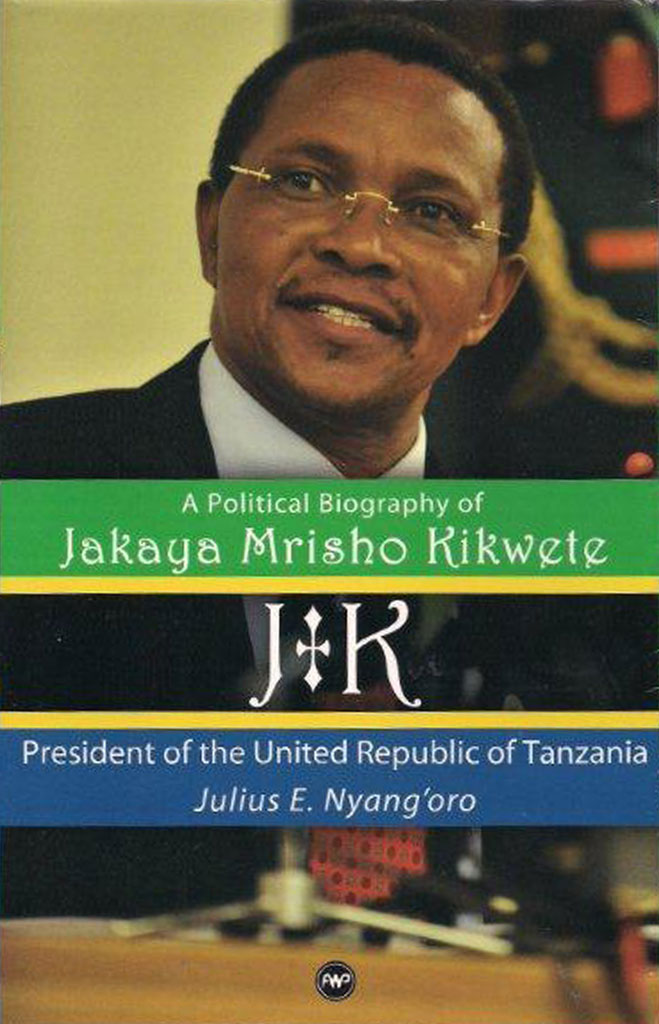
Jayaka Kikwete book cover

Jakaya Mrisho Kikwete has become famous in Tanzania and the world, but few understand who he is; Nyang’oro presents him to the world. He examines his humble beginnings, his rise to power and his avid attempts at advancing the country. This political story of the incumbent president up to early 2010 forms the first volume; the second volume will look at the outcome of the president’s policies. This work is recommended to readers interested in Tanzania politics, especially given the very few political biographies available.

Eloquently, Nyang’oro examines the president’s life from birth on 7 October 1950 at Msoga village of Bagamoyo District in Coast Region. His early involvement in politics started in the Tanganyika African National Union (TANU) Party Youth League at Kibaha Secondary School. Full-time party engagement as TANU secretary in Singida started in 1975 after university graduation; his leadership philosophy being influenced by the founding father of the nation, Mwalimu Julius Nyerere. At national level he became Deputy Minister of Energy and Minerals, then Minister of Finance under the second president Ali Hassan Mwinyi (1985 – 1995). For a decade thereafter he served as the Minister of Foreign Affairs and International Relations under the third president, Benjamin William Mkapa (1995 – 2005). The President’s first and commendable attempt at nomination for Chama cha Mapinduzi (CCM) party candidacy at the presidential election in 1995 was followed by a second and successful run in 2005.

Starting as a son of a District Commissioner in the 1950s, one of the highest posts held by Africans in the colonial administration, and having dedicated himself to politics from an early age, President Kikwete’s unmatched success in politics is unsurprising. Following selection as CCM candidate for the 2005 presidential elections, the president’s mixed emotions in his acceptance speech, with references such as the Chinese proverb ‘…the more you sweat in peacetime, the less you bleed during war…’ hinted how much this meant, and how prepared he was for the political battles to come.

Various successes of the president in his first tenure are highlighted by Nyang’oro. As African Union (AU) Chairman for 2008, along with continued efforts to stabilise the region, his key achievements were the Tanzania-led invasion of the Comoro islands to remove the unconstitutional government of Mohammed Bacar and facilitation of Kenya’s power sharing agreement after the 2007 election violence. Through the AU and the Southern Africa Development Community (SADC), he contributed to the establishment in Zimbabwe of the Government of National Unity in 2009, easing a long- standing dispute between the ruling party of President Robert Mugabe and the opposition party led by Morgan Tsivangirai. President Kikwete continues to advance the country’s international relations, a job he started well when Minister for Foreign Affairs. In-country, efforts to implement CCM’s 2005 election manifesto have included the fight against HIV/AIDS and Malaria, enhancing education with extended secondary school provision and the establishment of the legacy- beckoning University of Dodoma.

The President’s ‘Kilimo Kwanza’ (literally ‘Agriculture First’) initiative to modernise agriculture, Tanzania’s major employer, is not covered as explicitly. Very modest progress could be objectively reported on the implementation of good governance, with most of the grand corruption trials still dragging on in the courts; averting the country’s year-on-year severe energy crises; the government’s unsuccessful grappling with inflation; the deteriorating education standards; and the feet- dragging attitude towards regional integration. To the Tanzania majority, the fourth President’s delivery of ‘Better life for every Tanzanian, It is possible’ is a far cry from ‘New Zeal, New Speed, New Strength’, the CCM campaign slogan in the 2005 presidential elections.

In a straightforward manner Nyang’oro has presented chronologically the president’s life story, interweaved with relevant facts from Tanzanian and African history as well as brief country statistics. Although understanding the complexity of writing on a president still in office, he takes an utterly sympathetic view of the president. Whether this view is due to his choice of sources is hard to tell. The biography would have had added benefit by covering the wider political choices available in the country. While some interpretations provoke alternate views, others seem unfair assessments of past presidents or of Tanzanian democracy; eg, ‘… as expected he will still be president for another five years beyond 2010.’

I have the advantage of doing this review after the country’s October 2010 elections. The president returned to office indeed, though with a reported 61.16% majority, down from 80.28% in 2005 and a decreasing voter turnout-in contrast to the immediate past president, whose majority rose from 61.8% of 1995 to 71.7% in 2000 with an increased voter turnout. While the parliamentary election seats won by the CCM consecutively inched up from 1995 to 2005 under the chairmanship of the immediate past president, reportedly the CCM election seats tally after the 2010 election is back to the 1995 total. Clearly the popularity of the President and the CCM needs re-interpretation. Hopefully in Volume II the author has the opportunity to rigorously re-analyse the fourth President, thereby vitally contributing to the political knowledge of Tanzania.

Siya Paul Rimoy

EXIT FROM EMPIRE – A BIOGRAPHY OF SIR RICHARD TURNBULL by Colin Baker, published by Mpemba Books of Cardiff, 2010. ISBN 978 0 9542020 5 7. Book is available from Colin Baker at 55a Lon y Deri, Cardiff CF14 6JP for £17.50 plus P & P, UK £3, Europe £5.70, ROW £10.60.

For us the most relevant part of Colin Baker’s extremely detailed account of Dick Turnbull’s life and career is the short period of only four and a half years of his service as Governor and then Governor-General of Tanganyika. It saw the rapid advance of Tanganyika from being the least developed and least sophisticated of the three East African territories into becoming the first to achieve full independence, peacefully and without the internal tensions which had arisen in Uganda and in Kenya. Baker’s account contains more detail than has been published before, but the book is a biography, not a political history. That independence came so soon was chiefly due to the personal relationship that developed between Turnbull and Julius Nyerere. It was not what anyone had expected. Turnbull’s reputation when he came to Tanganyika was of the hard man from Kenya – regarded as “the hammer of Mau Mau, the oppressor of the nationalists, the associate of the wicked Kenya settlers” as Turnbull himself put it. His previous 27 years service in Kenya had shaped his character, and built his reputation. Baker reproduces copious extracts from Turnbull’s own letters and diaries describing his experiences and his generally low opinion of Africans and of his Colonial Service colleagues during his Kenya days. He highlights Turnbull’s belief in his own abilities and his determination to advance his career by whatever means. Turnbull’s prowess in long foot-safaris, especially in the harsh conditions of Kenya’s Northern Frontier District (NFD), deliberately out-walking his fellow officers, was well-known. Once he walked 200 miles to meet his DC, decided not to make the call, and walked back again. He planned to be seen by his superiors as more competent, more knowledgeable and more effective than his colleagues. After only 4 years service he was appointed DC Isiolo, and at the age of 39 became Provincial Commissioner in the NFD, a post that was often a stepping-stone to a Governorship. One might wonder how these attributes would have developed in the generally gentler environment of Tanganyika, if Turnbull had been posted there as the Colonial Office had initially intended? It just happened that the Tanganyika vacancy was filled unexpectedly by an officer transferring from Kenya, so Turnbull was sent to Kenya instead.

Little of that background was known when Turnbull arrived as Governor in Dar es Salaam, only days after his 49th birthday. The task facing him then was very different from what it had been in Kenya. The challenge was to manage the pressures of increasingly assertive African nationalism spreading across the continent, inspired by the independence of the Gold Coast in 1956, and given an immediate local boost by the holding in Mwanza of the founding conference of PAFMECA (Pan-African Freedom Movement of East and Central Africa) when Nyerere, as TANU leader, voiced demands for early independence of Tanganyika.

Baker examines the significance of Turnbull’s first meeting with Nyerere, only nine days after his inauguration, and while Nyerere was still awaiting judgement in the trial on charges of criminal libel against two British DCs that the government had brought against him. Knowing Turnbull’s record in Kenya in suppressing the Mau Mau insurrection, which had entailed working closely with the European community there, Nyerere had not expected him to talk about “working together to solve difficult problems” on the way to Independence. Turnbull knew that senior officials in the Administration and Police considered that TANU had extremely wide support throughout the country, and was capable of organising effective action that could completely disrupt normal Government activities.

How serious was the risk of widespread civil disobedience, leading to violence, if TANU’s demands for early self-government (madaraka) by 1959 were not met? There was little hard evidence, save for some incidents in Geita District in Lake Province that had revealed a degree of unrest and a potential for trouble that the Government would have found hard to control. Turnbull told the Colonial Office that the threat was real but political concessions would avoid conflict. Nyerere himself was being pushed by some in TANU who wanted even faster progress. The Colonial Office believed that Turnbull was yielding unnecessarily to fears of a breakdown of law and order. Turnbull took what security precautions were possible, but reported that he could not cope with a serious state of emergency without substantial military assistance, suggesting “eight battalions of British troops”. With considerable reluctance the Colonial Secretaries, first Lennox-Boyd and then Macleod, agreed to each progressive advance that Turnbull recommended, trusting in Nyerere’s good faith, and as each stage was passed so the next one became easier.

The final year as Governor-General was a boring let-down. Turnbull had no power, and his advice was not wanted. On the last day people gathered by the harbour entrance at Magogoni Street to see Turnbull’s departure aboard a Royal Navy frigate. After it had gone, they streamed back towards the town, passing the entrance to what had been Government House, now renamed State House or Ikulu. “Now this is all ours!” they exclaimed. The next morning the PWD began erecting new strong gates and a high security fence to replace the existing low wall around the grounds.

As well as the political record the book includes a revealing section about Life and Work at Government House, describing the human side of Turnbull’s personality, immensely softened from his earlier Kenya bachelor days by the pervasive and supportive influence of his wife and ever loyal companion Beatrice. Baker goes on to recount Turnbull’s later service in Aden, ending in disappointment and a sense of betrayal at being held responsible for the failure of the British Government’s policies which misjudged the force of Arab nationalism in that region.

The book is not a light read, but it is the substantive record of the nature, the career and the life of a man who played such a decisive role in the history of Tanzania.

David Le Breton

DAR ES SALAAM CULTURED STATES: YOUTH, GENDER, AND MODERN STYLE IN 1960’s. Ivaska, Andrew. 2011 Durham and London: Duke University Press. ISBN 978 08223 4 7705. p/b 312pp. £15.99.

Accounts of 1960s Dar es Salaam frequently focus on the ‘high politics’ of Uhuru and life in the new Tanzania. Ivaska’s investigation into official cultural discourse and interventions offers readers an opportunity to (re)live a parallel cultural politics – ‘the long sixties moment’ – as it was played out in the country’s capital. It is a sixties familiar to many; rebellion in afros, played to a soundtrack of soul music that competed against the establishment. As in other capitals of the newly independent African nations, Tanzanian officials attempted to clamp down on this promiscuous urban youth culture, and in so doing plunged themselves into the thick of sharp debates over the meaning of James Brown and hot pants. This was a time of vigorous contestation, and also of apparent paradox: while efforts were made to ban miniskirts and wigs were ceremoniously burnt in the national stadium, Ivaska describes how at the same time in Tanzania the ‘Maasai Progress Plan’ (‘Operation Dress-Up’) attempted to outlaw Maasai traditional dress. These campaigns are covered in scintillating detail, against a background of the shifts in urban demographics and the fault lines of late colonial debates about culture. Such conversations were carried out in the national newspapers that inform Cultured States, which is punctuated with quotes from newspaper letters sections that still resonate in public debate today: “It is a pity to see parents including young children,” wrote ‘Fairness’ in The Standard in November 1969, “mouth-open clapping hands at and even giving ‘tuzo’ [tips] to the actor or actress who performs sexual play (buttock shaking) properly.” The contests over culture are embedded in the book’s exploration of urban struggles around gender, generation, and wealth. These come together in a splendid section on the rise and fall of the university left.

A number of Ivaska’s central arguments cluster around the relationship between the state and cultural production. They provide a lens through which to engage broader themes animating African and postcolonial studies, particularly the issue of power. The kind of prominence official rhetoric achieved on the urban landscape, suggests Ivaska, was often testament less to the power of the state than to its limits. This resonates with Achille Mbembe’s call to approach the state and its subjects as bound up in a domain of ‘conviviality’ in which rulers and ruled are enmeshed in shared categories and discourses. Again, some of these conversations are on-going today: the running commentaries on rumours of scandalous liaisons between ‘city girls’ and elite ‘big men’ that was produced in Dar es Salaam’s popular tabloid press in the sixties, for example, are still being published in newspapers today – albeit now with lightly-censored, graphic photographs.

Ivaska concludes that the long sixties moment still lives on in Dar es Salaam today, and he ends with a brief description of public debate over contentious popular cultural forms at the turn of the century, including hip-hop music and style, beauty contests, comic books, and the ever-persistent miniskirt. New forms of media and communication mean that capturing this contemporary commentary now will take a different methodology to that which has been employed for this study, but one that Ivaska is clearly well-placed to undertake – and, upon reading Cultured States, it is hoped that he uses his considerable knowledge to do so. Cultured States is an engaging and readable commentary on high cultural politics that will appeal equally to those who remember the sixties in Dar es Salaam, and those who don’t.

Thomas Molony

THE LAST SLAVE MARKET – DR JOHN KIRK AND THE STRUGGLE TO END THE AFRICAN SLAVE TRADE, by Alastair Hazell, published by Constable & Robinson, London, 2011, www.constablerobinson.com. ISBN 978-1-84529-672-8 £16.99

The Slavery Abolition Act was enacted in Britain in 1833 and this brought to an end the trade in human beings throughout the British Empire, especially that between Africa and America. However, there were a few exceptions to the areas covered by the new law, the most notable of which was East Africa, where the trade still flourished and was one of the mainstays of the economy of the island of Zanzibar. This exception seemed to go largely unnoticed by the British public, who felt the job was done, and the political lobby to abolish slave trading had all but died out. However, those British subjects posted to East Africa. and in particular Zanzibar, were only too well aware of the continuing trade as dhow loads of slaves passed through the port with regularity.

One of those posted to Zanzibar was John Kirk, a Scottish physician and botanist. Kirk had already seen the trade whilst travelling with Livingstone up the Zambezi River, but never challenged it during his early days on the island. His attitude seemed to be ‘that of a man who gets involved only when he can do good’. As medical officer to the British Consul on the island he was not in a position to do anything, so did not initially get involved.

Hazell tells the story of how Kirk began to study the slave trade, the difficulties he encountered working within the politically charged arena of East Africa, facing unfair criticism at the hands of Henry Morton Stanley, but ultimately playing a pivotal role in abolishing the trade in that area of the world. The book has been well researched, clearly sets out the backgrounds of the major players and explains the events that led to the last slave markets being abolished. But it is not a ‘just the facts’ affair. Hazell manages to inject touches of description into the text which bring it to life. His knowledge of the area, and reading between the lines in the documents he has looked at, allows him to speculate on the kind of weather the island would be experiencing when an event took place , or to give an opinion on how one of the ‘characters’ really felt, despite the politeness of a letter.

These touches help draw the reader into the story and allow them to ‘live through’ the events with those involved. The build-up to Kirk getting the treaty signed felt a little bit like approaching the climax of a thriller as you are eager to find out how he managed to persuade people to abandon a practice which to them was as natural as trading in any other commodity and who saw nothing wrong with it.

‘The Last Slave Market’ is an important book that looks at the life of a relatively unsung hero of the battle against human trafficking and, as the evocative foreword hints, a reminder that the job is still not finished.

John Samson

STREET LEVEL – A COLLECTION OF DRAWINGS AND CREATIVE WRITING INSPIRED BY DAR AS SALAAM. Illustrated and compiled by Sarah Markes. Pub. Mkuki na Nyota 2011 pp 152 ISBN 978-9987-08-117-2.

Available from www.africanbookscollective.com and Amazon £18.95
British illustrator Sarah Markes was greatly taken with Dar es Salaam when she first visited in the year 2000 and dreamed of capturing its atmosphere in her drawings. When she finally returned to live in the city in 2002, she became increasingly unhappy to see more and more solidly built, often unique, old buildings being demolished piecemeal to make way for modern, multi-storey, steel and glass structures. She was determined to do something to raise awareness about what was happening and this book is the result. It is a collection of coloured line drawings interspersed with pieces of prose and poetry by local writers. (A few biographical details would have been welcome here.)

There are eight sections covering not only buildings but also the street vendors who depend on them for a living. A useful map shows the location of the buildings illustrated, and there is a glossary for non-Swahili speakers. In the opening section, architectural historian Karen Moon traces the history of the city from its foundation in 1862 and follows this with an analysis of the way a city’s architecture defines its identity. This is complemented at the end of the book by heritage specialists Simon Odunga and Jeremy Cross with a carefully argued but passionate plea to halt the destruction of that very identity.

The majority of the buildings in the book are (or were) to be found in the old Indian bazaar area of the city that used to be known as Uhindini, but not, as the book states, because most of its residents were Hindu; Uhindini was the common Swahili word for the part of town where Indian traders lived. Here, from the 1920s up until the 1950s, Hindu and Muslim alike invested their profits in highly individualistic buildings, many with names and dates displayed on the façade. Several German colonial buildings are included, as well as a few examples of art deco buildings in the Sea View area.

The book is only slightly marred by a few obvious spelling bloomers and minor factual inaccuracies: Gandhi is misspelled as Ghandi throughout and there are others that should have been spotted by a careful proof-reader. But this does not seriously detract from this delightful coffee table book that anyone with fond memories of Dar es Salaam would be happy to own.
G. Mawji

REVIEWERS

David Le Breton grew up in Kenya and was District officer and Magistrate in Tanganyika 1954-63, being Private Secretary to the Governor, Sir Richard Turnbull Feb 1959-Aug 1960.

Gloria Mawji is a British expatriate who has lived in dar es Salaam for over thirty years and taught at the International School of Tanganyika.

Graham Mercer has lived in Dar es Salaam since 1977, teaching in the elementary department of the International School of Tanganyika for 25 years before retiring to concentrate on writing and photography.

Thomas Molony is a Lecturer in African Studies at the Centre of African Studies, Edinburgh.

Siya Paul Rimoy is a civil engineer serving the Tanzania community on multiple fronts of academia, research and advisory through affiliation to the University of Dar es Salaam and the Industry.
LETTERS

In total agreement with the congratulatory message from President Kikwete introducing your 100th issue, I am glad to have the opportunity to write to thank you for your commitment and imagination concerning Tanzania both today and in the past. TA shows a great sense of history and in-depth contemporary issues from all your very professional writers.

….I personally am very excited every time TA arrives and fascinated by the detailed articles and news items. Despite being part of the Teachers for East Africa Scheme in 1962 and not returning home until 1986 I find all news of Tanzania, past and present, vitally important to me now….

Others of your readers will probably remember this Government scheme involving young graduates idealistic to do their best towards the development of newly independent East African countries…..it was during this period that I met and later married my dear late husband Charles the local agricultural officer and we moved to Kenya….
Mrs Veronica Ziegler, Dorset

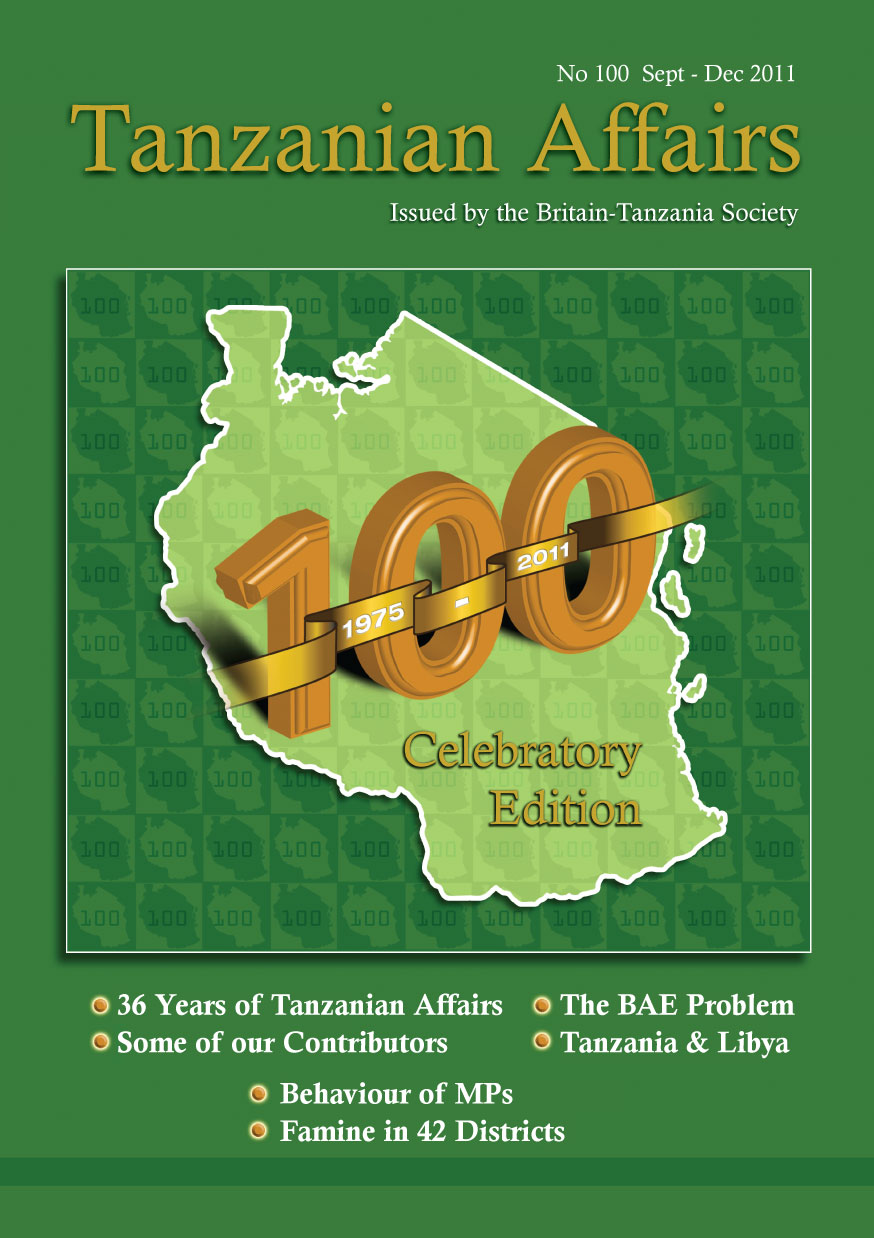
I write to congratulate you on your number 100 … It gave me huge pleasure to read the synopsis by edition number describing all the other material – reminding us of many memories. The celebratory cover also deserves special mention….
Ms C Coppard, London

We have received many other letters about our edition No 100 but space constraints have made it necessary to abbreviate the ones we have published above and to omit others. Much the same applies to several of the other articles we have received for which we wish to say thank you – Editor.

Dear Editor, your latest issue reminds me that I have meant for some time to write to you and say how good it is that TA is now online. Thanks for all your work. I still wonder however why it is not possible for the hard copies to have a contents page. TA is such a useful resource, but tracking back through issues is not easy.
Prof. Pat Caplan, Department of Anthropology,
Goldsmiths College, London

Space is always limited, and we have decided to stay with the current format with the major articles listed on the front page, and titles at the top of each page to aid navigation. Searching is best done using the website, where you can search for any text, and also restrict your search to a particular issue number or a particular article type (eg “reviews” or “obituaries” etc). There is also a “historic index” page listing the major articles in each issue – On-line Editor

Dear Editor, I am a regular visitor of TZAffairs.org. A few months ago I requested that all copies of TZ Affairs be made available online in the belief that it is the only undiluted and unadulterated account of events in Tanzania during those years. I am writing to sincerely express my thanks to the editorial board of TZ Affairs for deciding to spend time to see that those who are hungry for that record get easy access to it.
I wonder if you guys have copies of state-monitored newspapers of that time: for example Uhuru, Daily News, Mfanyakazi, Mzalendo and Sunday News. Front pages and editorials of those newspapers would be good reading for those interested like me. As I said before, I will volunteer anything in my power to help this website to expand its mission on spreading information about Tanzania.
Majura F. Selekwa, PhD. Assoc Professor/Mech Engineering, North Dakota State University.

CONGRATULATORY MESSAGES

Message from President Kikwete

President Kikwete

David Brewin (editor of Tanzanian Affairs)

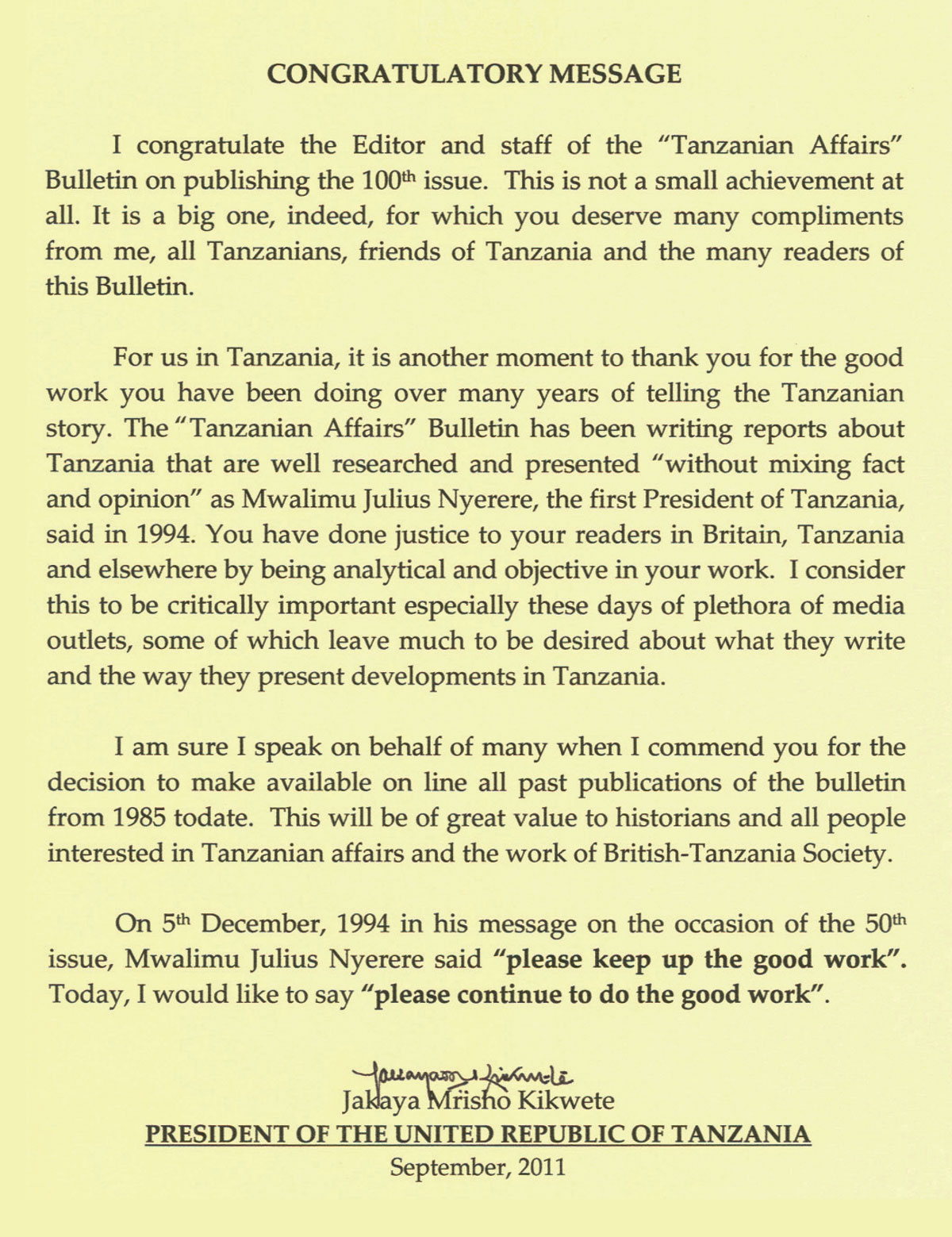
MESSAGE FROM PRESIDENT KIKWETE
CONGRATULATORY MESSAGE
I congratulate the Editor and staff of the “Tanzanian Affairs” Bulletin on publishing the 100th issue. This is not a small achievement at all. It is a big one, indeed, for which you deserve many compliments from me, all Tanzanians, friends of Tanzania and the many readers of this Bulletin.

For us in Tanzania, it is another moment to thank you for the good work you have been doing over many years of telling the Tanzanian story. The “Tanzanian Affairs” Bulletin has been writing reports about Tanzania that are well researched and presented “without mixing fact and opinion” as Mwalimu Julius Nyerere, the first President of Tanzania, said in 1994. You have done justice to your readers in Britain, Tanzania and elsewhere by being analytical and objective in your work. I consider this to be critically important especially these days of plethora of media outlets, some of which leave much to be desired about what they write and the way they present developments in Tanzania.

I am sure I speak on behalf of many when I commend you for the decision to make available on line all past publications of the bulletin from 1985 to date. This will be of great value to historians and all people interested in Tanzanian affairs and the work of British-Tanzania Society. On 5th December, 1994 in his message on the occasion of the 50th issue, Mwalimu Julius Nyerere said “please keep up the good work”. Today, I would like to say “please continue to do the good work”.

Jakaya Kikwete
PRESIDENT OF THE UNITED REPUBLIC OF TANZANIA
September, 2011

A MESSAGE FROM BTS VICE-PRESIDENT
The production of Tanzanian Affairs is one of the most important and most successful activities of the Britain-Tanzania Society. For 100 issues now it has kept us all up to date on economic, political, social and other developments in Tanzania. More than that – it has helped to keep the world at large informed about Tanzania. In 1984 David Brewin took over as editor and he and his correspondents have maintained a consistently high standard issue by issue. Congratulations are in order.
Derek Ingram

A MESSAGE FROM THE FIRST EDITOR
I have been so long associated with the Britain Zimbabwe Society – as its publications editor, conference organiser, Chair and President – that it is hard to remember that I began by editing the Britain-Tanzania Society newsletter. But the connection is a direct one. The Britain Zimbabwe Society was modelled on BTS though it has never attained its size or been able to emulate its development activities. I have put so much work into it over 30 years that I soon became a sleeping member of BTS. But I value it enormously. I owe everything I know about Tanzania for the past decades to its publications. I have long admired the Society’s ability to adapt with consistent loyalty and objectivity to ideological and political change. It remains a model for all other friendly societies.
Terence Ranger

A MESSAGE FROM THE PRESENT EDITOR

When a publication reaches 100 it is time to reflect about the past and the future.

In the case of Tanzanian Affairs, we hope to continue our policy of reporting facts and figures about developments in the country, as soon as possible after they happen. We do not want to preach to Tanzanians about what they should or should not do in their own country. We believe that our job is just to keep BTS members and other readers, who cannot find out what is happening in Tanzania elsewhere (in a concise form) informed about the latest developments there.

Maybe this policy is wrong. Perhaps we should take a more interventionist approach. Recent events in Britain (and Tanzania) including the scandal about the supply to Tanzania, by a British company, of inappropriate, out of date and over-priced radar equipment (with more than a touch of corruption on both sides) might, or might not, justify the expression of an editorial opinion. Especially when a British adjudication has ruled that the supplier should refund all the money to Tanzania, and then the supplier insists that it, the supplier, should determine how and when this money should be used by Tanzanians. Some might call this neo-colonialism!

What is the future of TA?
As editor I am often swamped with too much praise for my efforts. The work is shared amongst a team of volunteers, whose names are on the back cover of each issue. Jacob Knight, who edits the on-line edition and, for the main edition, selects the photographs and cartoons, writes quite a lot of the text, and, ‘puts the product to bed’ – or, more accurately, to the printer. He is especially deserving of thanks but the same applies to the whole team plus our numerous voluntary contributors.

There are some promising recent developments. The on-line edition of TA is attracting growing interest and the number of BTS members is also increasing.

However, there are also some danger signs about the long-term future.
Danger No 1 is that I, as editor, am not getting any younger. In fact there is plenty of evidence that I am getting much older! Yet, disappointingly, when an appeal was published in the BTS Newsletter for help in adding to our editorial team, there was no response. There are one thousand plus readers in our two editions!

If readers want TA to continue, and there is much evidence that they do, then someone who would like to be a volunteer reporter should please come to our aid. A phone call or e-mail from anyone interested and we will explain what we need in terms of editorial assistance.

Danger No 2. Letters to the editor no longer arrive. In the ‘old days’ we received many. Examples: A reader in No 38 was full of praise for a review by Alex Vines about the Swahili ruins in Zanzibar. Ronald Barton, in the same issue, corrected what he described as a ‘myth’, about responsibility for the establishment of the Rubondo Forest Reserve in Ukererewe. In No 46 there were two letters adding to an article we had published on the local manufacture of rifles in Tanzania. Paul Marchant, a regular writer in the nineties, was critical of many items he read in TA. In No 48 a Rwandan resident wrote about the naming of the Mjuru mountain in Morogoro region. The debate ‘English versus Swahili’ provoked many letters in the 1980s. In the nineties we had a letter from reader Ronald Munns in Australia questioning the genesis of the word ‘Mzungu.’ And so on.

Yet we have not had a single letter from a reader for almost two years! This is unfortunate as it must make our contributors wonder whether anyone reads the results of their efforts.

Why are there no letters nowadays? Perhaps letter writing is a dying art. People seem to prefer to Tweet or use Linkedin or Facebook. Maybe there is some fear about commenting on politics. Yet we have many Tanzanian readers who show no such fear in writing to Tanzania’s own remarkably free press.

So readers – give us a bit of encouragement to continue and if possible, give us a bit of help.
David Brewin (Editor)

36 YEARS OF TANZANIAN AFFAIRS – PART 1

The following contains brief notes on some of the more unusual and memorable stories to have featured in Tanzanian Affairs over the years, with apologies for the large number of articles which have been missed, and the inevitable personal bias in the selection. Please write in or comment online about any other articles that you particularly remember. Apart from the earliest issues (1 to 21) all the articles can be found online at www.tzaffairs.org
Jacob Knight

Issue 1 (Dec 1975) edited by Dr Terence Ranger is in A4 format with 12 pages, and brings news of the first passenger train leaving Kapiri Mposhi station in Zambia for Tanzania – the TAN-ZAM railway is born. TANU have published a booklet claiming that over 9 million people have been resettled in villages, but the Bulletin suggests that not everyone is happy, with widespread reports of resistance to villagisation.

Issue 4 (January 1977) announces the formation of the ‘Chama Cha Mapinduzi’ (Society of the Revolution) combining the two ruling parties – the Tanganyika African National Union (TANU) and the Zanzibar Afro-Shirazi Party.

The release from detention of Mr Abdulrahman Mohamed Babu and three others who had been condemned to death in Zanzibar, in absentia, for their alleged part in the assassination of the first President of Zanzibar, Sheikh Karume, is covered in Issue 6.

Issue 7 contains even more dramatic news – the Idi Amin regime in Uganda has invaded Tanzania in October 1978 and Tanzania is mobilising for war. The Bulletin has a new editor, Mr John Arnold, and it has grown to 18 pages.

Bulletin No 11 in December 1980 is a special issue devoted to the state of the Economy. Tanzania’s long period of negotiation with the IMF is under way.

Issue 15 covers the story of the hijacking of a Tanzanian aircraft and the subsequent arrest of the hijackers in Britain. A tragic sequel to this event is the death of Musa Membar after being held in administrative detention on his return to Tanzania (Issue 40).

Issue 19, now under the present editor, David Brewin, records the untimely death of Tanzania’s popular Prime Minister, Mr Edward Sokoine.

Issue 21 cover

President Nyerere’s visit to the UK is covered in Issue 21 (July 1985), where in a “short but tough” interviewon BBC Newsnight with Peter Snow he was asked: “Is there not some way in which the system, particularly the agricultural system, the communal socialism which you introduced in Tanzania… has caused the failure of your country to produce what it should be producing?” The President replied: “What do you say to that ? African agriculture is backward in socialist and non-socialist countries alike. In my country we use the hand hoe. In capitalist countries in Africa they use the hand hoe. That defines the limits of what the peasant can do. The difference between a socialist country like Tanzania and a non-socialist country is that the burdens of poverty are shared better in a socialist country than they are in a non-socialist country.”

Familiar A5 cover

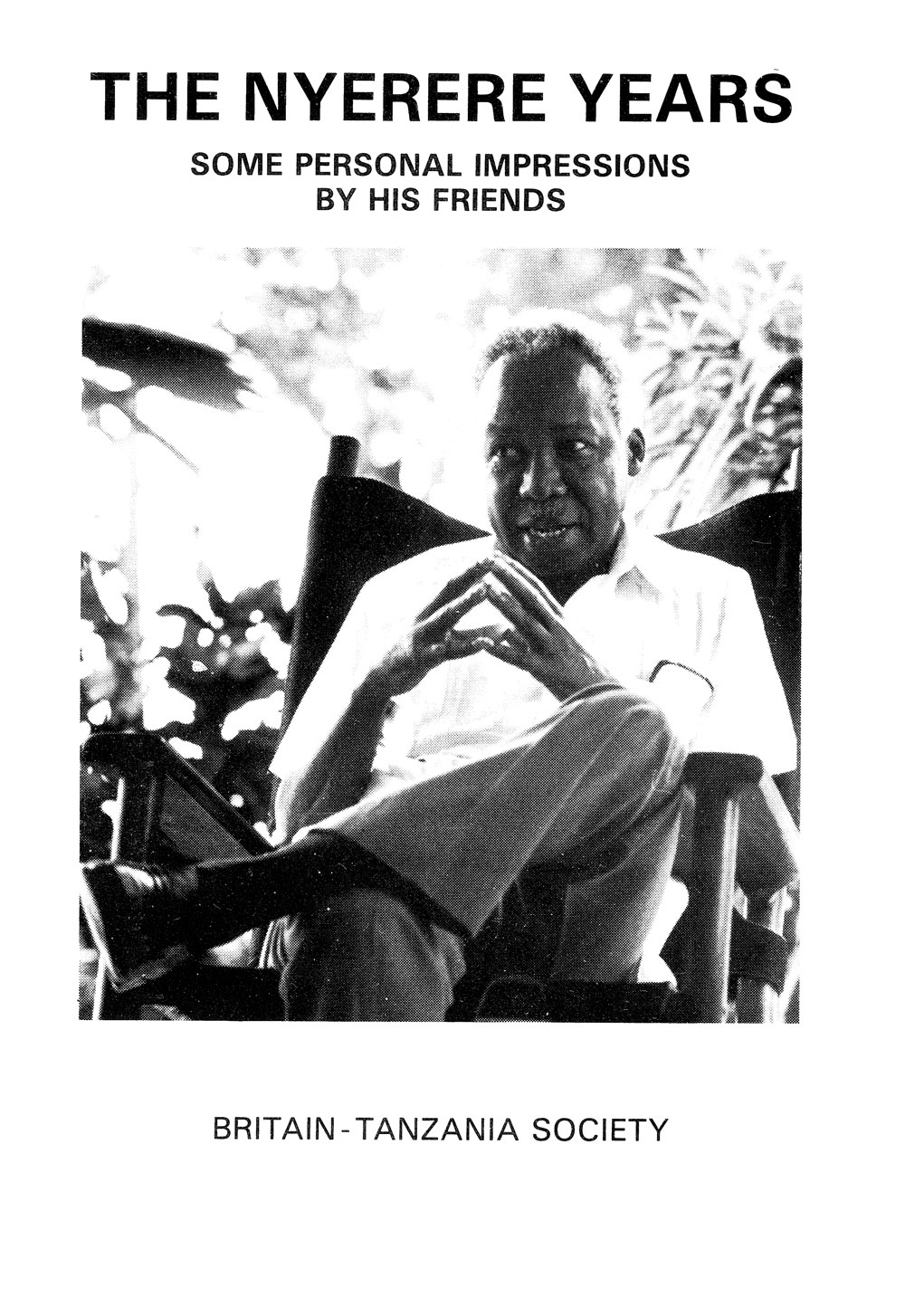
Issue 22 (Oct 1985) marks the change to the A5 booklet edition which we are all familiar with (cover designed by Richard Moon). It includes a special supplement “The Nyerere Years” to mark the end of his Presidency, containing essays on Nyerere from his friends including many members of the Britain-Tanzania Society – well worth a read.

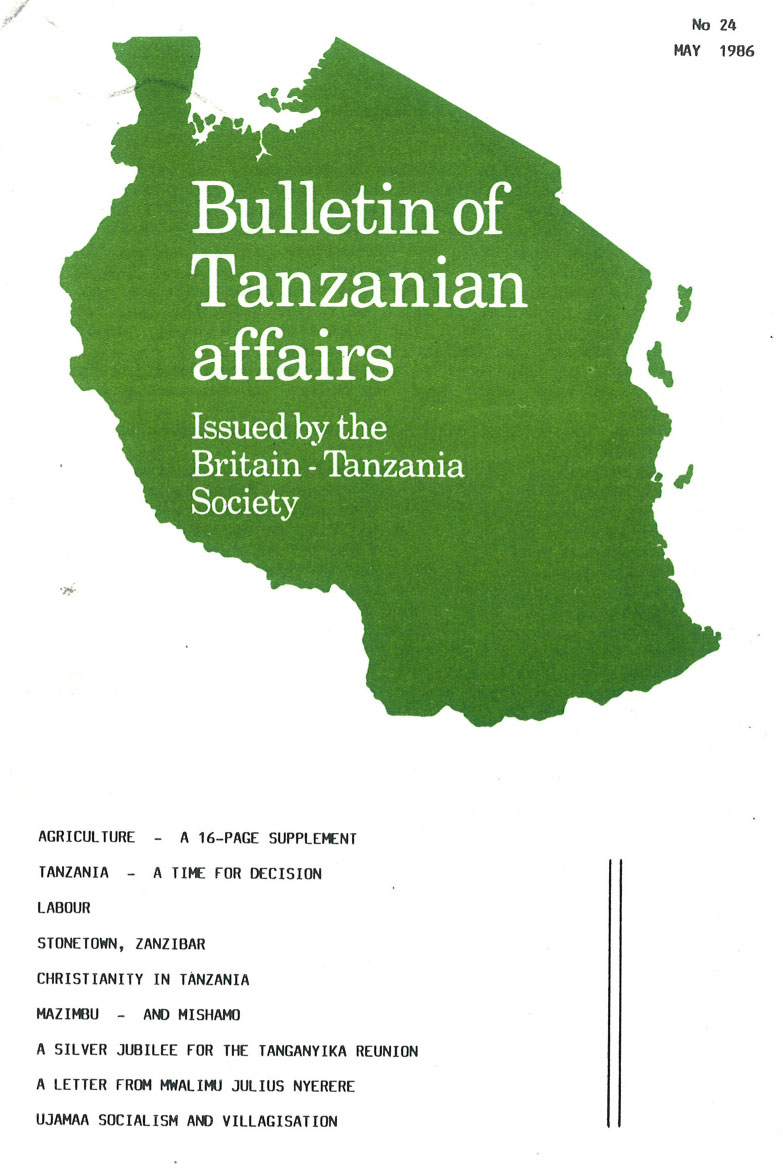
Issue 24 gives weight to the economic problems facing the new President Mwinyi, but also highlights agriculture, with articles about peasant farming, the problems with transportation, and traditional knowledge on microclimate modifications (such as wind protection by scattered obstacles and trees/bushes). Randal Sadleir reviews a BBC documentary on the groundnut scheme – forty years on.

Issue 25 (1986) includes an item from the Daily Telegraph about the fate of a team of donkeys which had been used by a team of British explorers retracing the steps of Victorian explorer Stanley. After discussions involving Prince Philip, Prime Minister Mrs Thatcher, the RSPCA, and others, the Tanzanian Air Force is able to rescue them and fly them from the shores of Lake Tanganyika to Kenya where donors had provided funds to accommodate them in an animal retirement home near Nairobi. The issue also includes the first mention of the AIDS epidemic in Tanzanian Affairs noting that 125 cases of “Ukimwi” (the new Swahili word) have been reported with research workers estimating that 0.01% of inhabitants of Kagera are potential carriers.

As well as analysis of the economic recovery by Roger Carter, Issue 26 (1987) notes the sad accident during the visit of Mother Teresa to Hombolo, and covers the Kilombero sugar estate where three people were killed and many more injured by Field Force Units, called in after workers demonstrated over non-payment of overtime earnings. There is also a useful guide to the Parliament of the United Republic of Tanzania written by the speaker of the National Assembly, Chief Adam Sapi Mkwawa.

Reporting on an international conference under the heading ‘The Arusha Declaration 20 year after its Publication’ Professor Terence Ranger writes about the cheerful Christmas bustle of Arusha where for the first time in a while there are abundant goods in the shops. Many conference delegates felt that the crisis in agriculture arose because the Declaration was not effectively carried through; others felt that the Declaration was a flawed document; but everyone could agree that many of the problems stemmed from weak and corrupt party management.

An article on “Informatics Technology” in Issue 27 estimates there are currently 400 computers in Tanzania. There is also an article about Tanzanian Adam Salim and Kenyan Fadhili Williams who both claim to be the author of the legendary song “Malaika”. “A Queen’s Scarf” by Mr J.T.Purvis recalls how puzzlement over a grave inscription on a grave in Old Shinyanga led him to find out more about the “QS” decoration awarded to Major A.H Du Frayer QS OBE. Four scarves were knitted by Queen Victoria shortly before her death and awarded to soldiers who had joined the forces as rankers and had first been recommended for the Victoria Cross for an outstanding act of bravery.

In depth analysis of the difficult on-going negotiations with the IMF by Reginald Herbold Green and Roger Carter features in Issue 28. Godwin Kaduma writes about Makonde carvings and their role in ritual, sadly a meaning lost in the many mass produced carvings. A brand new Uniflote ferry, purchased for the Kigamboni crossing, has broken down after a month’s use – the Sunday New’s columnist Adam Lusekelo suspects corruption, as do many others, and invents a history of the two Tanzanians given the task of buying the ferry “… we must remind you that this matter is of the utmost importance” “Yes, I know how important this ferry is to you but…” “Who’s talking about the ferry? We are talking about our cut”…

Mwalimu Nyerere’s decision to stand for re-election as CCM chairman is discussed in Issue 29, after many had expected him to retire. The Minister of Finance Cleopa Msuya estimates Tanzania’s population as 23 million, almost double that of 1967. The problem of stowaways from Tanzania is attracting attention, with an estimated 1,000 Tanzanian youths leaving the country illegally in search of jobs. Mwalimu Nyerere criticises parents who think their children will easily acquire wealth in foreign countries.

Articles by John Budge, Caroline Hanks and Robert Whitcombe look at the problems caused by the Larger Grain Borer Beetle which has been decimating stored food crops mainly maize and cassava. Packaging insecticide in sachets suitable for treating six debbes of maize and printed with instructions in Swahili has proved very successful when combined with an extensive education campaign.

Issue 30 contains news of dramatic events in Zanzibar. In the run up to the 1985 presidential elections, Idris Wakil had narrowly beaten Seif Shariff Hamad to get the CCM candidacy. Following the election, President Wakil appointed Seif Shariff as the Chief Minister in an effort to ensure unity. However, it has ended badly with Seif Shariff Hamad suspended, thrown out of the CCM party and later arrested amid accusations of attempts to destabilise the Union (Issue 31, 33 and 34). An article by Michael Hodd entitled “From Nyerere to Neo-Classicism” about some of the reforms initiated by President Mwinyi generates a vigorous debate in the letter pages of next issues.

Issue 31 covers President Mwinyi’s visit to London and meetings with the Queen and Prime Minister Thatcher. Charles Amour’s well informed piece on the history of radio broadcasting in Tanzania answers the question “Why no Television?” (Tanzania still being without any mainland TV broadcasters). A letter from Roy Galbraith in response to a request from a reader, confirms the current price for maize (when available) is 20 TShs a kilo, with government price controls still in operation on staple foods (exchange rate £1=175 TShs).

Issue 32 (Jan 1989) carries news of Tanzania’s devaluation of its currency. An article from SHIHATA reviews a drama presented at the Moshi International School on the anniversary of the first ascent of Kilimanjaro in 1889, with dialogue in English, Kiswahili and Kimachame. Extracts from a paper by Col. F.S. Swai give a history of the metamorphosis of the King’s African Rifles into the Tanzania People’s Defence Force following the mutiny in 1964, noting how the army was politicized and made up of soldiers who identified with the ruling party TANU.

An article by editor David Brewin about his experiences on a visit to China is particularly interesting given the increasingly large role that the country is now playing in Africa. David’s several requests to interview someone who had worked on the TANZAM railway construction are met positively, but the bureaucratic machine swings slowly into action and all interviews are eventually declined. China’s residents are facing some of the same problems as Tanzania (high inflation and weak currency, Economic Reform and Structural Adjustment), but it is already clear that rapid progress is being made.

Christine Lawrence’s review of “The Snakeman” by Margaret Lane gives a brief view of the life of C.J.P Ionides, a singular character living in Newala on an escarpment overlooking Mozambique. He has “escaped from the tyranny of possessions” and survives comfortably by running a snake-catching business.

Issue 33 includes analysis by Suleman Sumra of the Education for Self-Reliance programme based on a case study village in Handeni. The conclusion is that it did not lead to fundamental transformation of the education system, partly because of dependency on external teaching materials but also because the village leadership was authoritative and hierarchical, limiting the participation of youth. Anna Pincus describes the successful tour of the four person Mellstock Band playing folk music, unaccompanied carols and a Dorset broom dance.

Issue 34 (1989) describes how President Mwinyi took the lead in proposing the world ban on ivory trade. T.C.E. Congdon’s “Nine Holes in Mufindi” gives a fascinating impression of the botany and wildlife of this beautiful golf course. The “Fifty Years Ago” section covers the internment of Germans in Tanganyika in 1939 and the first effects of war. Shirin Spencer reviews a programme on Channel 4 about the “Lightning Bird” or hammerhead (related to the heron and stork) which has legendary powers over rain and floods. Some 400,000 people are now estimated infected with HIV, with 12% adult infection levels in Kagera, and as high as 32% in Bukoba town. There are already concerns on how Tanzania will be able to cope with the number of orphans.

Issue 35 contains an article by Mark Horton on “Digging up Zanzibar” – a survey of Zanzibar’s archaeological sites and monuments. A related article in issue 37 by Alex Vines lists the threats to Tanzania’s monuments, including simple neglect but also theft of sites for building materials.

Headline from the Daily News

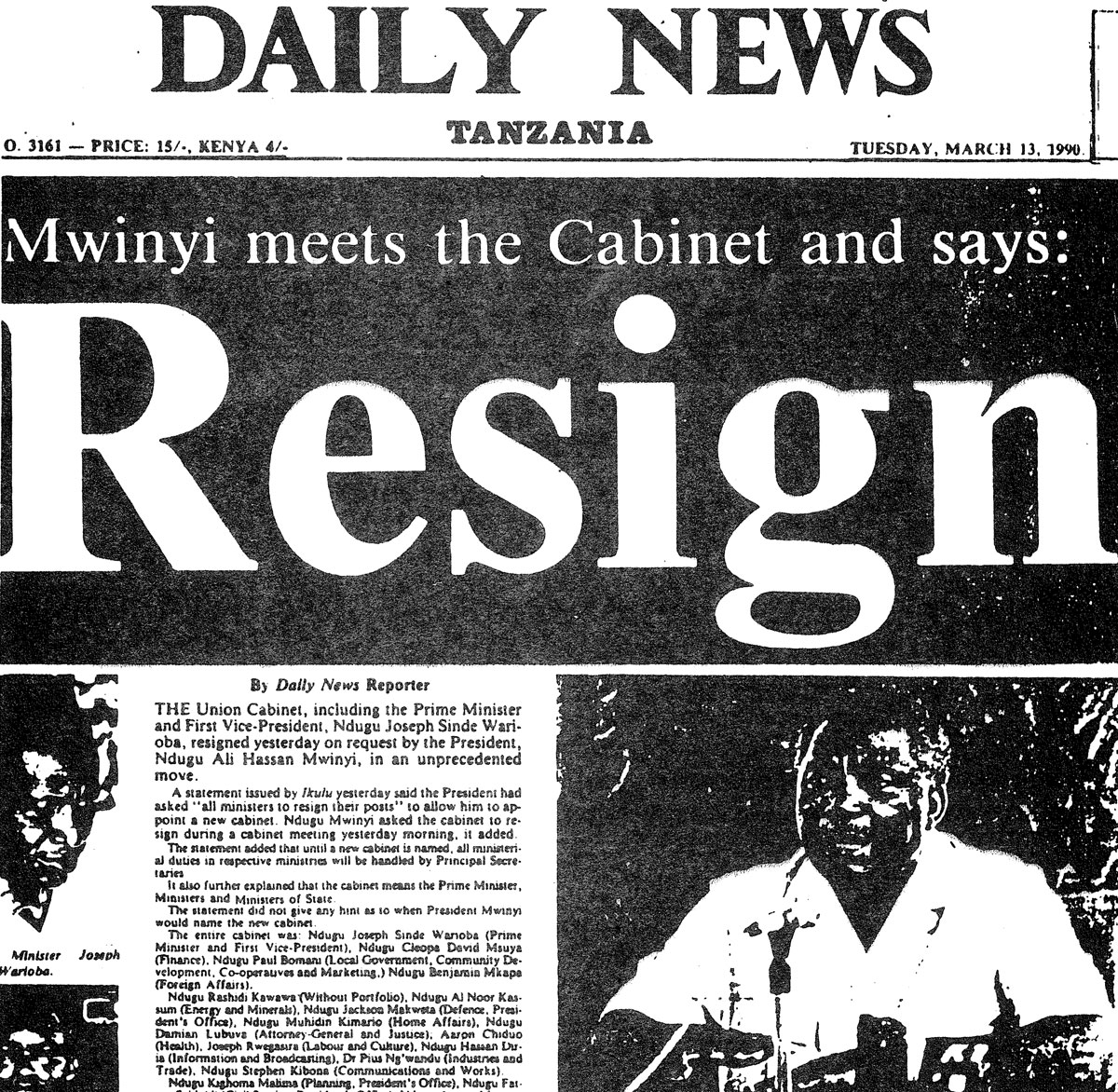
Issue 36 carries the dramatic news of President Mwinyi’s three minute cabinet meeting, where he asks all ministers to resign. The reason was corruption, and the President’s desire to wipe the slate clean with a new cabinet (although several members were re-elected). Among the new ministers is Jakaya Kikwete (Energy, Minerals & Water). John Malecela is Tanzania’s new High Commissioner in London, where he has an immediate and positive impact building cordial relations with Prime Minister John Major, elected shortly after (Issue 37). However, he is soon transferred back to Tanzania to become Prime Minister (Issue 38). Nelson Mandela and his wife Winnie visit in March 1990, and are entertained by Mwalimu Nyerere and President Mwinyi, addressing large crowds at the football stadium and also visiting Zanzibar to see the grave of former president Abeid Karume.

Issue 37 (Sept 1990) includes analysis of the 1988 census results by Clive Sowden – Dar-es-Salaam has 1.2 million inhabitants, with Mwanza the second city far behind at 183,000.

Issue 38 carries the election results, with President Mwinyi re-elected with 95.5% of votes and Dr Salmin Amour elected in Zanzibar although there one third of the electorate did not turn up to the polling stations. David Brewin writes about DANTAN (the Denmark Tanzania Association), comparing with the Britain-Tanzania Society, and suggesting how each can learn from the other.

Issue 39 (May 1991) is dominated by accounts of Minister for Home Affairs Augustine Mrema’s successful and popular attempts to reduce corruption. It also covers the “great debate” on multi-partyism. “My Father, and the useful plants of Zanzibar” by R.O.Williams Junior follows his father’s career as Director of Agriculture in Zanzibar, a job which left him with plenty of spare time in which he collected and catalogued the plants of the Isles.

My First and Second Impressions of Tanzania” by John Drew in Issue 40 contains interesting comparisons between Tanzania and Kenya, and background on the work of Tear Fund in Iringa. There is also a forerunner of this article “We have reached number 40 after 16 years” giving a history of the publication and ending with a prophetic statement by the editor “Maybe it will eventually reach No 100. Who knows?”

The University of Dar-es-Salaam continues to face protests as it opens after a 6 month break, this time over the removal of popular Vice-Chancellor Prof. Mmari. An article in Issue 41 entitled “Three Decades at the University” Paul A Isbell paints a turbulent picture, linking the ideological struggles with the fall of the Berlin Wall and the collapse of socialism in the Soviet Union.

Issue 42 (May 1992) brings the dramatic news of “Mageuzi” with the historic declaration of Multi Party Politics. While the majority of Tanzanians (80% according to the Presidential Commission) wanted to continue with the single party CCM system, Nyerere supported the change as did most other leaders. An article on “The BBC and Tanzania” contrasts a talk on Radio 4 “Africa: Deadline for the Dark Continent” by Michael Buerk, and on BBC1 the “Comic Relief Snappily Titled and Utterly Sponditious Stab of Explaining why so Many People in Africa are so Damn Poor”, featuring Tony Robinson visiting various parts of Tanzania.

In Issue 43, Michael Ball describes an unforgettable “Day on Lake Victoria” for a group of VSO volunteers, complete with huge crocodiles and escaped convicts, and ending with a six hour row in the darkness after their boat runs out of petrol. Eight private Bureau de Change are now operating in Dar-es-Salaam, under the new Foreign Exchange Act.

Issue 44 (Jan 1993) covers the return of Oscar Kambona from exile in London, but his party TADEA receive little support. David Gooday writes of a fascinating “Visit to Kindwiti – the Leprosy Centre” where he meets Canon Robin Lamburn.

Issue 45 covers religious tensions between Christians and Muslims and debate about Zanzibar’s membership of the Organisation of Islamic Conference (OIC). The Revd Christopher Mtikila is advocating the breakup of the Union and various other populist policies like Indigenisation (Issue 46). An article by Ray Abrahams investigates witch killings in Sukumaland and Njombe district. John & Margaret Cooper write that “We Wake to the Song of Birds” in Mafiga Morogoro, where they live with a large collection of animals.

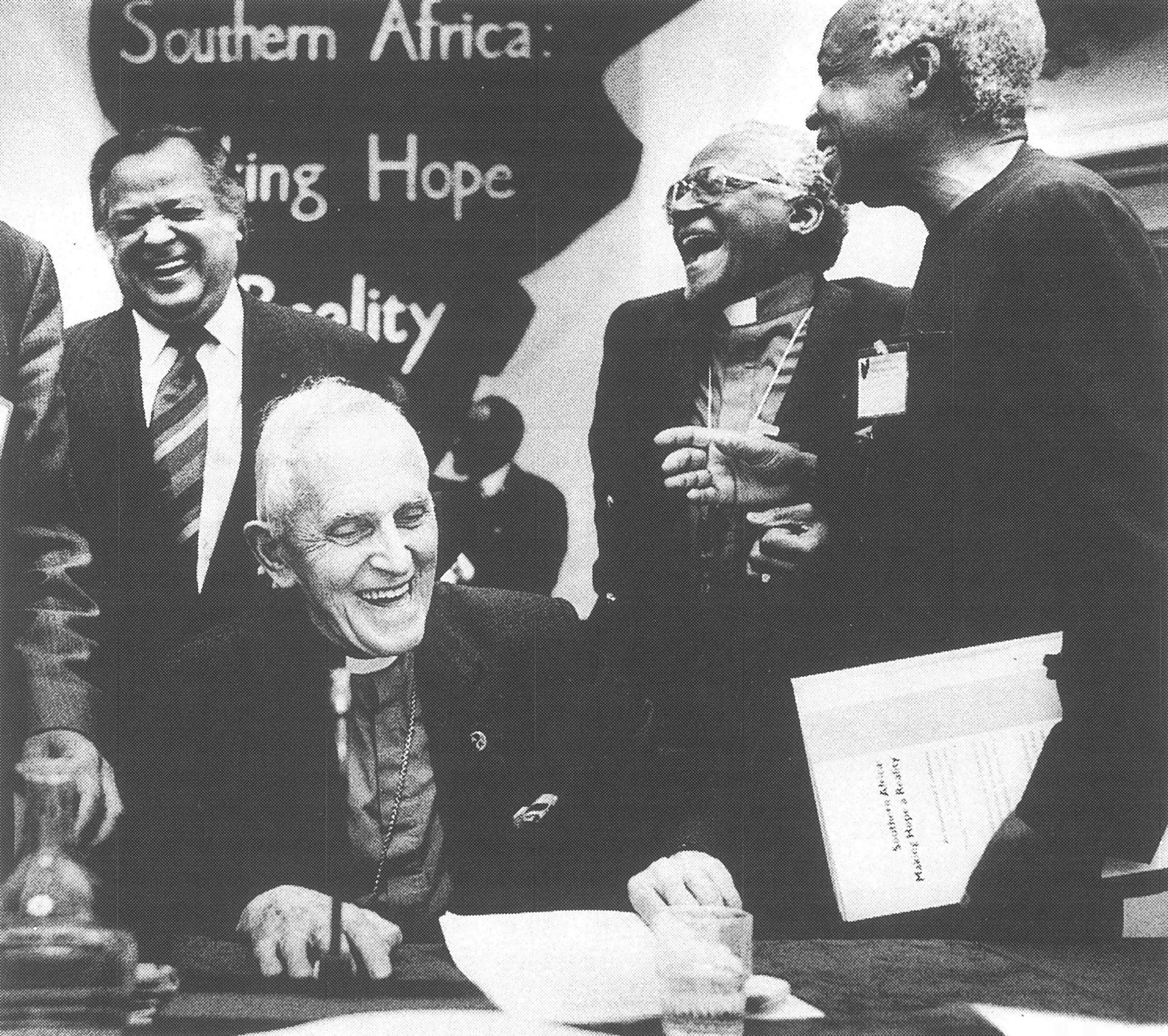
Bishop Trevor Huddleston with Mwalimu Nyerere, Archbishop Desmond Tutu and Shridath Ramphal


Issue 46 includes the lovely photograph reproduced opposite of BTS president Bishop Trevor Huddleston enjoying his eightieth birthday party in the company of Mwalimu Nyerere, Archbishop Desmond Tutu and former Commonwealth Secretary General Shridath Ramphal.

As well as an article by Roy Willis on the growth of Sumbawanga driven by cross border trade, Issue 47 (Jan 1994) contains a detailed analysis of the AIDS crisis, estimating that 800,000 Tanzanians are now HIV infected, and that by 2010 up to 1.5 million people might be infected (which proved very accurate – UNICEF figures for 2009 were 1.3-1.5 million). There is still confusion and dissent as to the link between HIV and AIDS, and whether AIDS actually exists, and TA includes a strongly worded rebuttal of such “naïve views” by David Mabey.

Issue 48 explores the role of John Okello in the 1964 Zanzibar revolution, and his subsequent return to obscurity in his home country of Uganda.

Ngara, which almost overnight became Tanzania’s second city due to the influx of 350,000 Rwandan refugees, is described in Issue 49, noting the disturbing way in which Hutu rebels were allowed to continue to persecute and murder Tutsis and moderate Hutus within the refugee camps. An amusing article “Home Sweet Home” describes how a bee relieved the author Alastair MacEwen’s boredom while filming sleepy lions in Ngorogoro Crater, and almost became a pet. Two TV stations begin broadcasting in Dar-es-Salaam (ITV and CTN) and are immediately involved in a High Court battle over rights to screen the World Cup football matches.

36 YEARS OF TANZANIAN AFFAIRS – PART 2

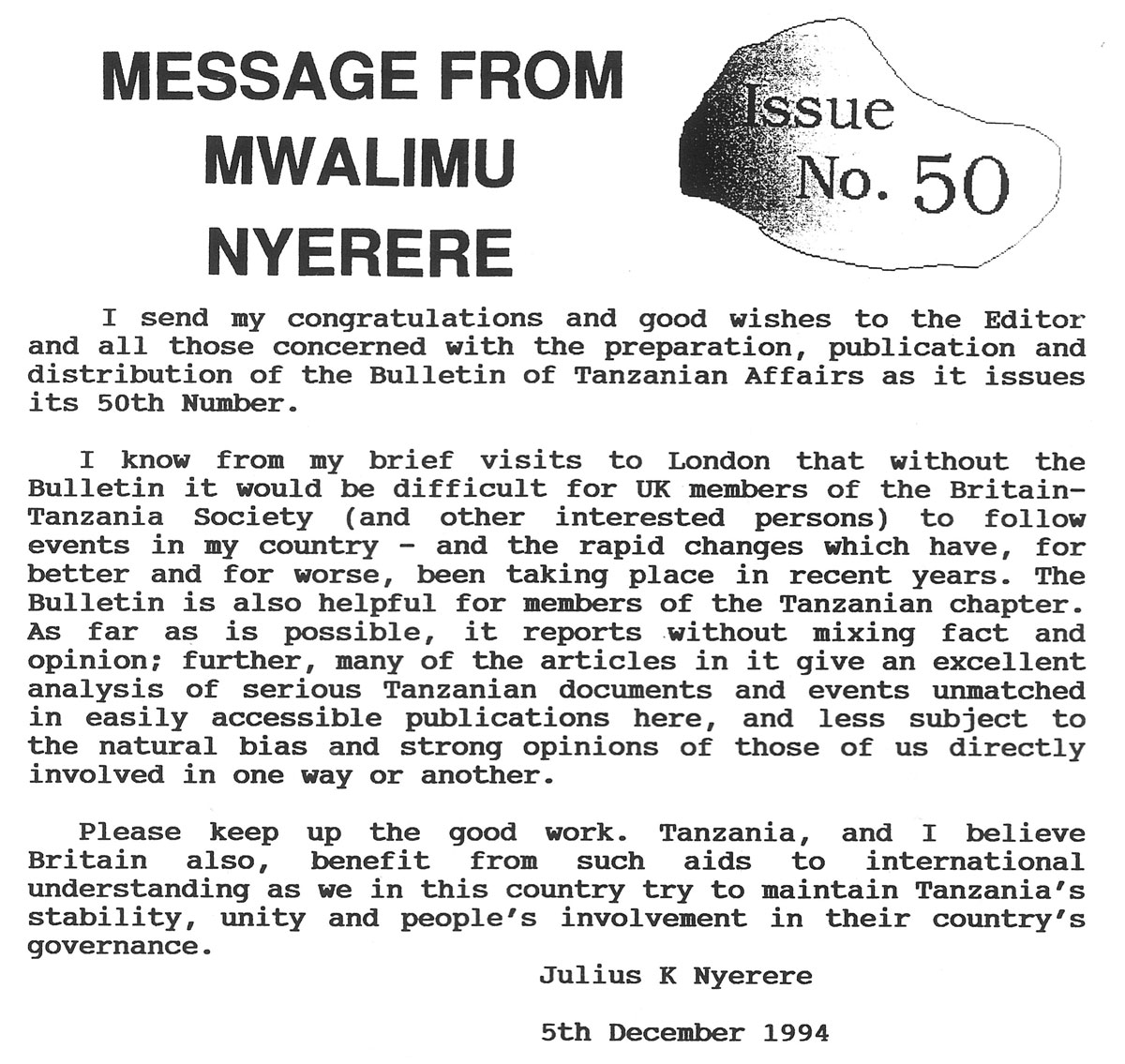
Message from Mwalimu Nyerere


Issue 50 (January 1995) contains a message from Julius Nyerere (reproduced above).

Issue 51 (1995) features an article by Christine Lawrence concerning the negative impact of the Canadian supported wheat scheme on the local Barabaig communities in Hanang district, and the projects that CIDA have started to try and redress the situation. The scheme was started with grand aims of improving Tanzania’s self reliance, (Issue 24), but little or no consideration given to the 40,000 Barabaig who depended on the land for a living. The project was ended in 1994 (“A Giant Mistake” – Issue 47), and Issue 57 contains a review of the excellent book “Pastures Lost” by Charles Lane on the project and its aftermath.

An interesting article by Alan and Heather Scott looks at the increasing numbers of human deaths between 1990 and 1994 as a result of crocodile attacks in Korogwe, many occurring when the town water pumps failed and people were forced to collect water from the Pangani River.

A detailed exploration of Taraab music in Zanzibar in Issue 52 concludes that the direction of the art form is being pushed by a network of women’s taraab clubs, moving in full circle back from the “swahilified” tarrab of Siti binti Saad back towards an “ideal” form of taraab as performed by Culture Music Club under Akhwani Safaa (Janet Topp Fargion). Lake Victoria is a “Sick Giant … murky, smelly and choking with algae…”, and the Nile Perch has come to dominate causing the extinction of 200 of the 400 species of fish that used to inhabit the Lake (People & the Planet).

Issue 53 covers the elections of October 1995 with Benjamin Mkapa elected president with 62% of the vote. The controversial election in Zanzibar is covered by editor David Brewin with the first of his “Election Diaries”. An arresting story “Popobawa is Dead” concerns the mob killing of a man suspected of being a “Popobawa” (a man with magical powers who rapes men and women in their homes). It was subsequently found that the man was a mental patient who had come to Zanzibar for treatment (Henriette Jansen).

Issue 54 notes the requirement for all Tanzanian nationals travelling to Britain (and vice versa) to obtain a visa. The TAZARA railway is operating at a loss, partly blamed on the successes of road hauliers, which is to be a recurring theme over the next decade.

A letter from John Cooper describes a pleasant and peaceful trip to Tanzania from their home in Rwanda, spoiled only by the noisy and extremely violent videos shown on the buses, and wonders if the British Council or other body might not be able to provide something more informative!

Issue 55 (Sept 1996) details Tanzania’s “Titanic” disaster when the MV Bukoba capsized on Lake Victoria on May 21st. In the sad days following the tragedy, some 392 bodies are recovered, but many more left in the wreckage which becomes a permanent tomb. An article on “Kilwa – from decay to development” describes the changes afoot to improve the dirty and derelict buildings in Kilwa Kivinje, including plans for a road from Dar-es-Salaam, private fishing industry growth and the development of the Songo Songa gas field. This is balanced by another article “The Demolition of Dar” lamenting the demolition of 176 plots to make way for 20 “ultra modern” structures with up to 26 storeys.

The deputy Prime Minister Michael Heseltine chooses Tanzania for his holidays, spending three weeks visiting game parks and Bagamoyo. Prince Charles and his sons William and Henry and Mrs Hilary Clinton and daughter Chelsea also visit in 1996/7.

Issue 56 contains a comparison of school days in Britain and Tanzania by Rob Grant. Jodie and Zawadi have very different experiences and the classroom atmosphere varies tremendously, but some things unite the two.

Issue 57 highlights the drought affecting four million people in nine regions of the country, and severe water shortages in Dar-es-Salaam. These are followed by severe floods in late March leading to the deaths of some 40 people in Kilwa district. The “Mpemba Effect” is a curious phenomenon whereby hot milk (or other liquids) will sometimes freeze more quickly then cold milk when placed in a freezer. Matthew Green tracks down Erasto Mpemba, finding him working for the Wildlife Department at the “Ivory Room” in Dar-es-Salaam. An Observer article “Barred from the Animal Kingdom” gives the views of three Maasai who have been on a speaking tour of the UK, complaining about the Tanzanian government driving them from their lands to create the Mkomazi Game Reserve in Same district. On the other hand the Trust which runs the Reserve claims an increase in elephant numbers from 2 to 1000 over a 25 year period, and that the area has recovered from the overgrazing and serious erosion that took place when the Masaai were there… This provokes angry letters in TA 58 vigorously defending the Game Reserve and pointing out the numerous errors in the Observer article.

Issue 58 (Sept 1997) covers the visit of Julius Nyerere to London, where he gave three speeches despite suffering from malaria, and received a lengthy standing ovation at the London School of Economics. Mwalimu celebrates his 75th birthday in Dar-es-Salaam, attended by over 1000 people. An article by Elias Songoyi describes the relationship between “Sukuma Singers and the State” and how singer Kalikali went too far in criticising the local party officials in 1965 and was detained in prison for two years, after which his songs were very different. Another artist, Mwinamila, was also critical of the state, but escaped imprisonment, the article suggests this was because his criticism was later (in the early 1980s) when perhaps the government was more confident, and also because he was a close associate of Nyerere.

An extract from VSO publication ORBIT in Issue 59 notes that Tanzania currently has only 3 telephone lines per 1000 people. Satellite phones are thought to be the solution to communication in remote areas. Anita Stomberg and Ben Rawlence write about the “Night Life in Dar-es-Salaam” varying from international discos such as “Club Billicanas” through to clubs playing Zairean Soukoss known as “Ndombolo”.

Issue 60 (May 1998) brings news of religious riots at Magomeni Mwembechai Mosque leading to the death of two people and 261 arrests. Simon Hardwick’s article “Kimbiji Revisited” recounts his return after 40 years to this village on the far side of the Kigomboni ferry – he finds the village much changed, but is still met with great hospitality. A dog in Sumbawamba is destroyed on the orders of a primary court magistrate after his owner gave him the name “Immigration” which the Magistrate deemed likely to cause a breach of the peace in the village. This causes outrage among animal lovers both in Tanzania and internationally (Majira).

A day in the Life of Wadi Moja (Ward One)” by VSO volunteer Jean Cooper tells how an accident involving football supporters travelling in a lorry led to a sudden influx of 64 patients turning the ward into a battlefield. Notwithstanding the emergency, all patients are greeted by the nurses “Habari za afya” “Nzuri kidogo” (this from a man with blood pouring from his chin and leg in plaster from toe to groin!)

Issue 61 covers the horrific events surrounding the bombing at the American Embassy, killing ten people and injuring scores more. The Tanzanian High Commissioner in London Dr A Shareef congratulates Tanzania Standard Newspapers for entering the internet and the “fast lane world”, and invites visits to the High Commission’s own website. The issue also records the mass in St Alban’s Anglican Church attended by President Mkapa and Mwalimu Nyerere for the late Archbishop Trevor Huddleston KCMG. A service was also held in Westminster Abbey.

Issue 62 includes the first of Ben Rawlence’s articles “Kisa wa Kisasa” (also in Issues 63 and 64) where he gives some modern and colloquial Kiswahili, including a new meaning for “buzi” (goat).

Roger Carter comments in Issue 63 about the prospects for debt relief and criticism of the Heavily Indebted Poor Countries (HIPC) debt initiative.

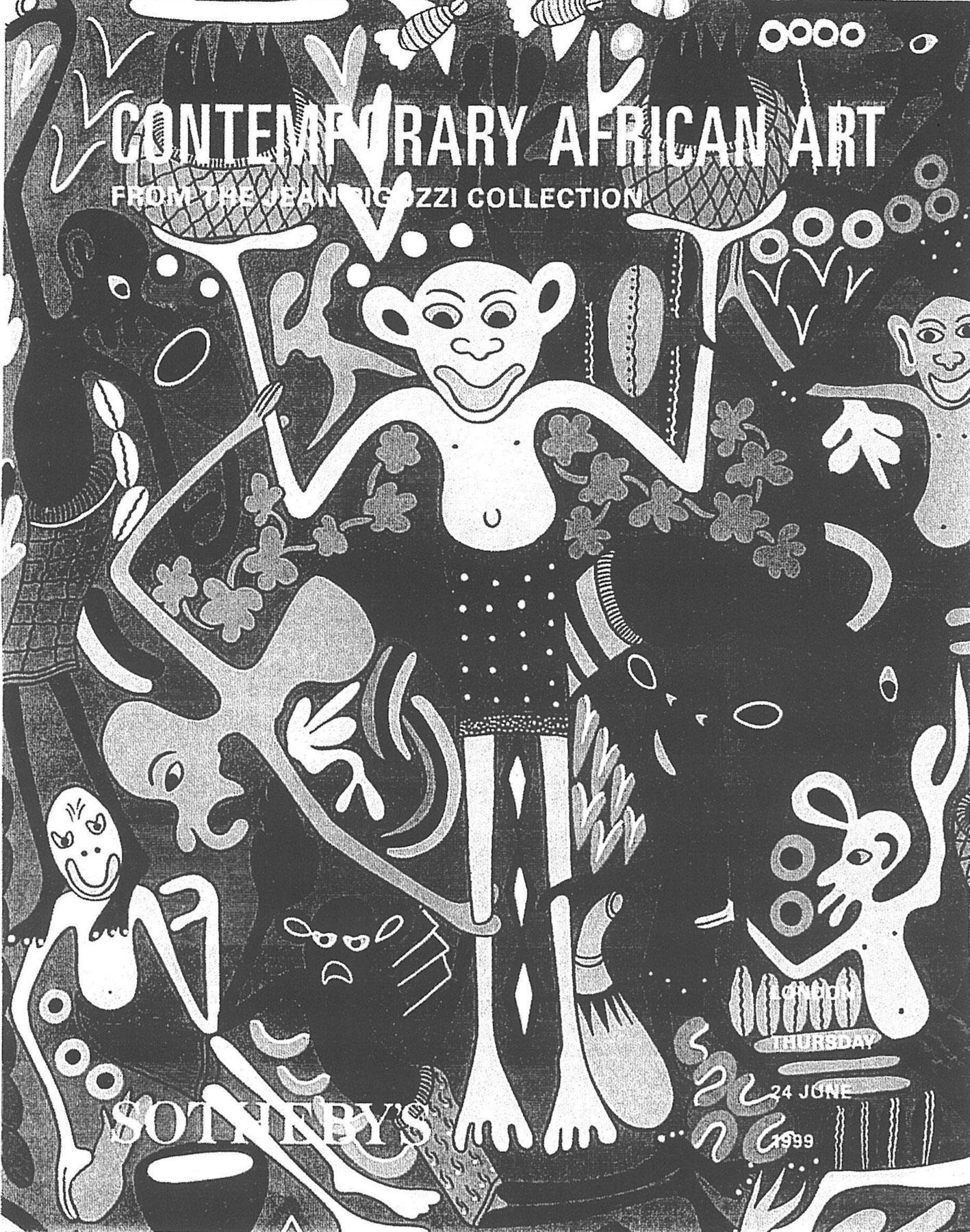
Contemporary African Art Poster


Elspeth Court reports in Issue 64 on the sale of a painting by Georges Lilanga di Nyama at Sothebys for £8,200 more the three times the estimate.

Issue 65 (Jan 2000) is dominated by coverage of the funeral and memories of Mwalimu Nyerere (1922-1999). A meeting in London organised by the Jubilee 2000 campaign and attended by Prime Minister Frederick Sumaye condemns the World Banks HIPC initiative, and Dr Shareef compares it to a patient who is on his deathbed in a hospital, and instead of being given a blood transfusion is instead offered two aspirins a day to relieve the pain ! Issue 66 also features extracts from a paper by Ron Fennell on “Nyerere and the World Bank”.

As well as coverage of the build up to presidential elections, Issue 67 (Sept 2000) contains a sad extract from the Sunday Telegraph by Lindsay Hawdon describing a bus journey where an emaciated son boards with his mother and dies during the journey.

A large part of Issue 68 (Jan 2001) is taken up by David Brewin’s “Personal Election Diary” which gives readers a clear, believable and unbiased account of the “shambles” in Zanzibar.

An item from the New African in Issue 69 revealed the mobile phone revolution with Tanzania now having as many mobile phone lines as fixed lines. A letter from Tim Hardy described a memorable concert with the late Bibi Titi Mohammed in Mbeya in 1958 where as the solitary mzungu he was singled out for particular attention!

Issue 70 (Sept 2001) covers the increase in mining for gold and Tanzanite, and the first mention of the controversial Air Traffic Control system and the resulting dilemma for Prime Minister Tony Blair, as reported in the Financial Times.

Issue 71 brings news of another “agreement” in Zanzibar, but as is becoming something of a recurring theme, there are setbacks almost immediately. On a more positive note, the government abolishes school fees for primary schools as a result of a World Bank interest-free loan. There is an article about how Tanzanian dance bands such as Twanga Pepeta are managing to overcome the former domination of Zairean (Congolese) stars. Colin Hastings writes about a interesting safari while making a video about Tanzanian cultural tourism. The issue also included a review of “Bwana Shamba” by Peter Wilson recounting his experiences in Kilosa in the 1960s.

Issue 72 highlights disquiet over the Mkapa government’s privatisation policies, and the increasing stake held in particular by South Africans. However, economic indicators seem to show a positive story. Paul Harrison paints an evocative picture of Zanzibar at Idd el Fitr, though the Forodhani food market is closed due to a recent cholera outbreak.

Issue 73 contains information from Peg Snyder on the fifty Festival of the Dhow Countries which has ZIFF (Zanzibar International Film Festival) as its centrepiece. An interesting article by Alex Perulla describes an afternoon at FM Club in Kinondoni and the emerging Hip Hop music scene in Dar-es-Salaam. A train crash between Igandu and Msagali near Dodoma leaves 281 people dead and 371 injured.

I had been happily married” begins an article from BBC’s Focus on Africa (in Issue 74), but a meeting with a traditional healer fails to provide the longed for children and instead prompts divorce. Mary Punt writes of the delights of travel with the “Scandanavian Express Bus Company” from Dar-es-Salaam to Iringa and the rest of the senior citizen’s safari.

Issue 75 highlights the differences in reporting of the Iraq War in Tanzania and the UK, and contains the census result that Tanzania’s population is 34 million, with 2.5 million of those living in Dar-es-Salaam.

Indigenisation (uzawa) is a hot topic in Issue 76 after MP Iddi Simba published a book suggesting that indigenous Tanzanians (as distinct from Asian Tanzanians etc) should be favoured under government economic policies. The calls are quickly rejected by the CCM party. The “50 years ago” section includes a report on the return of the Sultan of Zanzibar from the Queen’s Coronation in 1953, noting “… under his inspired leadership there is probably no more contended community than that to be found in Zanzibar”- the Editor has added a post-script that the Zanzibar Revolution took place three years later !

Issue 77 contains excited speculation that oil will soon be discovered, as prospecting continues off the coast and in the Rufiji Delta. Meanwhile, the World Food Programme starts emergency food aid for those in the centre and north of Tanzania worst affected by the long drought and floods. There is an interesting article by Martin Walsh and Helle Goldmann on their efforts to establish whether the Zanzibar Leopard (Pathera pardus adersi) is extinct. Another article confirms that a specimen of the ancient fish Coelocanth, suspected to have vanished 65 million years ago, has been caught in Kilwa.

The increasingly serious dispute over the use of water from Lake Victoria and the Nile Basin is covered in Issue 78 (May 2004).

New cover introduced in 2004

Issue 79 marks a change in cover design to incorporate a photo, in this case of the ITV studios in Dar-es-Salaam to illustrate an article on the rise of television in Tanzania, with five channels now operating in Dar-es-Salaam and several nationwide.

Water Carrier in DSM - Birgit La Cour Madsen / ActionAid UK.

Issue 80 concentrates on the newly privatised Dar-es-Salaam water supply service under criticism from ActionAid. The firm City Water, with the backing of UK firm BiWater, is said to be mismanaging the supply leading to the city being dry for several days on end. Eventually the government decides to terminate the contract (Issue 82) leading to a protracted court case that BiWater eventually loses (Issues 89,92). The issue also contains an obituary for Joan Wicken, the dedicated socialist and former Personal Assistant to the late Mwalimu Julius Nyerere, who made several contributions to TA over the years.

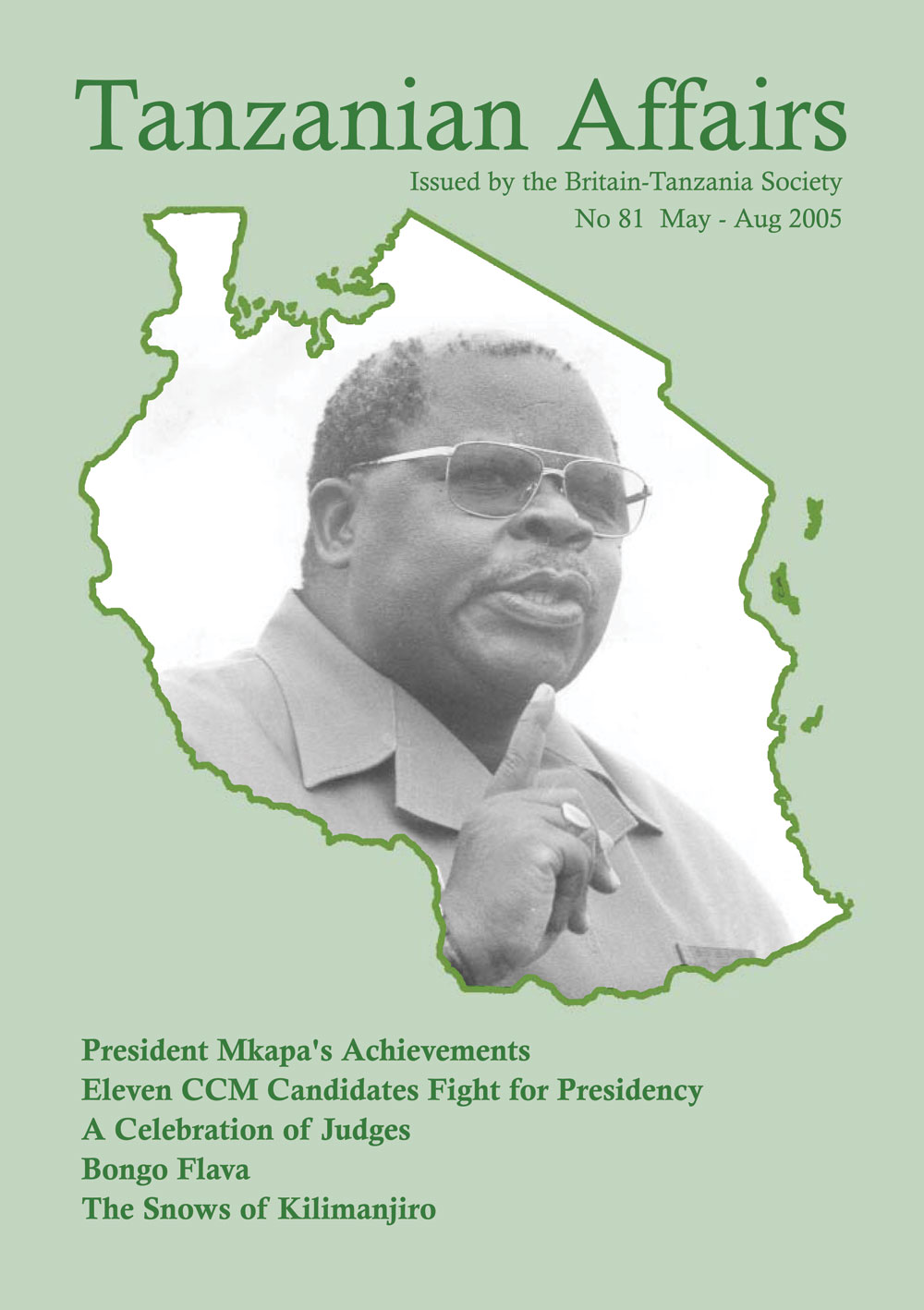
Issue 81 (May 2005) includes “A Celebration of Judges” by Jim Read describing the events to mark the Silver Jubilee of the Tanzanian Court of Appeal.

Ben Rawlence gives the background to the forthcoming elections in Zanzibar in Issue 82 and the unhappy history of former elections there.

Jakaya Kikwete’s great election triumph (winning 80% of votes) is covered in Issue 83. Less positive reading is David Brewin’s election diary from Zanzibar, with photographs of “Janjaweed” voters alleged to have been brought in from the mainland to support the CCM.

Suspected ‘Janjaweed’ voters in Zanzibar 2005 (TA 83) David Brewin

The Walking Dream” in Issue 84 by Jane Bryce describes her return to Moshi and the house where she spent a happy childhood. Much has changed and is unfamiliar, but she is welcomed into her former house by Victor the new owner, and shares ugali and stew with him.

Issue 85 (and 86) cover the furore surrounding the film “Darwin’s Nightmare” about the infanticidal behaviour of the Nile Perch taken as a metaphor for human society, and implying that weapons are being smuggled into Tanzania in exchange for fish.

An article in Issue 86Tradition versus Modernity” covers the exchange visits between First Lady Salma Kikwete and the Swazi Queen Mother. There is criticism from Tanzanian feminist activists of Mrs Kikwete’s approval of the reed dance ritual, which provokes comparisons with the “Miss Tanzania” competitions which are gaining popularity in Tanzania. Karl Autun recounts the journey of an ngalawa (outrigger canoe) from Bagamoyo to the Norwegian Maritime Museum in Oslo.

Issue 87 covers the possible schism in the Anglican Church over the issues of homosexual priests, same-sex marriages and women bishops, and the views of Tanzanian bishops. President Kikwete visits the UK and speaks at a dinner hosted by the Britain-Tanzania Society, and receives a Newcastle United football shirt from Prime Minister Blair.

An article by Hildebrand Shayo highlights the issue of “BioPiracy” where Western companies take out copyrights on indigenous plants from developing countries and reap the profits from turning them into cosmetics, medicines etc.

As well as coverage of Business & the Economy by Joseph Sabas, Issue 88 includes a complaint on TA’s coverage of the meeting of the Anglican primates in Dar-es-Salaam, although the letter from Roger Bowen concludes “I remain a fan of your magazine and often recommend it”. Faye Cran describes how a Tanzanian with the unfortunate name of Hitler was ostracized from his community when he started losing fingers and toes, but eventually finds his way to the Upendo Leprosy Centre in Arusha where he now lives with 50 other leprosy sufferers and 31 children.

Issue 89 examines the allegations of corruption surrounding the BAE Radar, Bank of Tanzania Twin Towers, and Richmond Electricity Contract and other cases which are to rumble on for many more issues. Kasia Parham’s book “Dogodogo” is introduced, telling the stories of some Dar-es-Salaam street children at the Dogodogo centre which over the past fifteen years has helped some 1,500 children.

Issue 91 features an article on Uwanja wa Fisi (Hyena Square) an area of Dar-es-Salaam renowned for prostitution, which was visited by US star Kelly Rowland in support of the Staying Alive Foundation.

Peter Leonhardt describes a project to deliver internet connectivity to schools, hospitals and council offices in a remote part of the Serengeti via a single satellite link in Issue 92. The issue also contains a scholarly article on “Who conceived/led the way to Ujamaa?” by Lawrence Cockcroft, Gerald Belkin and Ralph Ibbott. John Sankey writes of an almost forgotten incident in Tanganyikan aviation history in 1920 involving a crash landing near Tabora during an attempt to fly from London to Cape Town (with something like 15 stops en route!). New co-editors Donovan McGrath and Jacob Knight are introduced.

John Meadley writes in Issue 93 about “The New ‘Choo Men’” who are servicing pit latrines in Dar-es-Salaam using small carts able to negotiate the small alleyways and provide a much more cost effective service than vacuum tankers.

“Kilimo Kwanza”, the governments new priority policy for agriculture is covered in Issue 94 (Sept 2009) , while Issue 97 covers the run up to the presidential election, and also features an article on the controversial “Serengeti Road” project.

Kikwete’s second term election success (61% of the vote) is covered in Issue 98 together with the formation of the Zanzibar government of national unity. Finally Issue 99 contains news of Pastor Masapila and the brew he is distributing in Loliondo which is claimed to be a “miracle cure”.

SOME OF OUR CONTRIBUTORS

Many hundreds of people have contributed to the columns of Tanzanian Affairs over the years. Sadly, many of them are no longer with us.

We would like to have presented, in this special issue, extracts from all of them but constraints of space and time make this impossible. We have also had to restrict the period covered for the same reasons. We decided that the earlier contributions, because of their historical significance, would be of the greatest interest, and the contributions mentioned below are all from the first fifty editions of TA. For those not seeing their contributions mentioned, we are sorry; but hope this will not discourage you from contributing again.

We can hardly thank enough all the people who have contributed, none of whom asked to be paid. Without them we must wonder whether TA would ever have existed.

I also feel privileged to have met so many of them and to have benefited from the wealth of knowledge and experience they have shared with us.
So, thank you again.
David Brewin (Editor).

Mwalimu Julius K. Nyerere, whose name must have appeared in almost every edition of Tanzanian Affairs since the beginning (in 1975), paid tribute to TA in our 50th edition.

Graham Mytten contributed a regular digest of Tanzanian News in the 1970s.

John Arnold wrote on many subjects when he was the second editor of Tanzanian Affairs, in particular, on the ‘ideological war’ over villagisation in the eighties.

Roger Carter, co-founder of the Britain-Tanzania Society, wrote a regular column on the economy for many years.

David Leishman. The first of his many contributions was in 1978.

Jill Shankleman, FAO Advisor, reviewed Andrew Coulson’s article on agricultural policies in Tanzania in 1979 (followed by many other articles over the years).

Professor Reginald Green wrote several robust articles on Tanzania’s economy in the 1980s.

Ann Brumfit reviewed an article on language development in 1981.

Martha Honey reviewed a BBC broadcast on the controversial Preventive Detention Act in 1982.

Peter White of the Polytechnic of Central London wrote on the bus and coach industry.

The Right Rev George Biggs, who was a missionary priest (mostly in Masasi) from 1937 to 1973, gave his impressions on returning to Tanzania after many years as Bishop of the Seychelles.

In July 1982 Ruth Carr reviewed a book comparing Tanzanian and Mozambican policies on rural development and came down heavily in favour of the latter.

N M Mulokozi of the Institute of Kiswahili Research in Dar University was full of praise for the two-volume novel by Aniceti Kitereza on peasant life in Ukerewe in pre-colonial times.

Professor C K Omari of Dar University wrote on the interaction of religion and society in 1983.

Philip Raikes contributed a comprehensive piece on the history of coffee in Tanzania in 1984.

The Nyerere Years pamphlet


President Kenneth Kaunda of Zambia, Bishop Trevor Huddleston and Sir Shridath Ramphal, former Commonwealth Secretary General, paid tribute to Mwalimu Nyerere on his retirement in edition no. 22.

Peter Yeo contributed several articles on the co-operative movement in Tanzania over the years.

Professor G R V Omari, Vice- Chancellor, Sokoine University of Agriculture, was a constructive critic of Tanzanian Affairs in the 1980s.

Peter Chonja reviewed the report of the Presidential Commission on Education in 1986.

Christine Lawrence, a pillar of support over many years, together with a friend, Shirin Spencer, reviewed a performance in London by actors, singers and dancers from the Bagamoyo College of Art. Described as a fusion of Tanzanian and British traditional music with jazz, rock and pure drumming (plus the ‘Tanzanian Tango’), the production was titled ‘Nutcracker – A Village Party’.

Professor Juma Ngassongwa, who was later to become a Cabinet Minister for many years, contributed an analysis of ‘Peasant Farming in the time of President Nyerere’ to a 16-page supplement on agriculture in edition no. 24.

Sisal plant

Sir Roger Swynnerton, President of the Tropical Agricultural Association, wrote an obituary in 1987 on George Lock, who from 1930 to 1959 had devoted his agricultural service in Tanganyika to sisal research, the development of sisal crop husbandry and the improvement of sisal fibre processing at a time when the country was the biggest producer of sisal in the world.

In 1987 S A V Bowman wrote a letter to the editor in which he said that “Tanzanian politics, evidently the main preoccupation of the Bulletin (as it was then known) are, to me, the least interesting aspects of the country….”.

In 1989, James S Read, Professor of Comparative Law in London University (and later Senior Lecturer in Law at Dar es Salaam University College), a frequent contributor, wrote an article on ‘Justice in Tanzania – Lessons for England’.

Reviewing in 1989 a highly critical article on a World Bank Urban Shelter Project, Dr Carole Rakodi, at that time a Lecturer in Town Planning at the University of Wales, pointed out that the author was wrong to treat the Bank as a scapegoat and had ignored mismanagement in Tanzania (for example, the abolition of local government) and class tensions within the local population.

Mrs Keiko Collins, a book translator, and Mrs Midori Uno of NHK Radio Japan, contributed two articles (‘Tanzania and Japan’ and ‘Tanzania and I’) in edition no. 33 which explained how wrong Mrs Uno had found Japanese preconceptions about Tanzania to be when she went there as a volunteer and how there had been, since 1978, a Japan -Tanzania Association whose membership included three former Japanese ambassadors in Dar es Salaam.

Basil Hoare, a consultant in agricultural extension and training and a former staff member of the FAO in Rome, contributed frequently to TA.

T C E Congdon, Estates Director of Brooke Bond Tanzania Ltd wrote in 1989 an unusual and amusing analysis of the flora and fauna of a golf course, under the title ‘Nine holes in Mufindi’.

Mrs Eirlys Park, at one time a local correspondent to ‘The East African’ and the ‘Tanzania Standard’, wrote in no. 34 about the large collection of Makonde sculpture, built up by the Maides family, then living in Arusha.

Dr Mark Horton, the well known TV archaeologist who has done a great deal of work in Tanzania, first contributed to TA in 1990.

Dr Noel Thomas, Principal of the Teacher Training College in Swaziland, who has contributed many times to TA, reviewed an article on ‘Education and Culture of Tanzanian Teachers’ in no. 35.

In 1990 ‘A History of Leprosy in Tanzania’ was reviewed by Dr Peter Christie, a consultant paediatrician who advised on family planning in Tanzania.

Dr James Scullion wrote about ‘Grassroots Strategies in the Fisheries Industry’ in no. 36.

Dr Per Eklund, a Swedish researcher/consultant on rural development, wrote about population pressure and fertilizer policy in no. 36.

Dr Deborah Bryceson wrote on famine in East Africa in no. 37.

Geoffrey Wilkinson served in the Agricultural Department in Zanzibar from 1948 to 1954. In TA no. 41 he reviewed ‘Just Your Cup of Tea’ a collection of stories about the early years of tea development at Mufindi.

Sir James Farquharson, the former head of the East African Railways, wrote in no. 42 (a special issue called Mageuzi at the start of multi-party politics in Tanzania) on the discussions with the World Bank on the proposed Tanzania/Zambia Railway before the Chinese offered to construct it.

Judith Holland organised, very effectively, many seminars and other gatherings for the Britain Tanzania Society for several years.

In no. 43 in 1992 John Leonhardt, a biologist, wrote a review of a BBC programme, ‘Mpingo: The Tree that Makes Music’, whose wood was described as the only material from which you could make clarinets.

In no. 44 Cheridah Coppard, who described herself as ‘an amateur bird watcher’ reviewed an article by the International Council for Bird Preservation.

Those interested in the traditional musical instruments of Tanzania enjoyed the review of a book on the subject in 1993 by John Brearly, then an ethnomusicology student.

‘Suddenly, with a speed I did not believe possible for a beast of such vast, barrel-like proportions, a hippopotamus rose beneath us’. So began an exciting article in No. 46 by Ben Freeth, who described himself as a sky jumper.

In 1993 Professor Gelase Mutahaba, then Director of the Administration Division of the Commonwealth Secretariat, wrote a review of a comparative study of Public Sector Personnel Management in three African countries, including Tanzania.

Bevan Waide, then Advisor to the Parastatal Reform Commission, wrote in no. 49 a critical review of a study of state enterprises in Tanzania following nationalisation. There had been many problems but also many constructive initiatives He concluded that policy towards the parastatal system had changed as dramatically and almost as rapidly in Tanzania as similar policies in Hungary or Poland, but without a change in the ruling party.

Well- known Law Professor Issa Shivji made available to us in no. 50 an interview he had given to Haramata on the report of the Presidential Commission of Inquiry into Land Matters.

Chief Justice Francis Nyalali gave a wide-ranging and revealing speech at SOAS in 1994 which described how the functions and power of the judiciary had changed substantially during the early years of independence. It was published in TA.

Dr Margaret Snyder, founding director of the UN Development Fund for Women (UNIFEM), whose first book (written with Mary Tadesse) was ‘African Women and Development’, reviewed a controversial book about Ukimwi (AIDS) in 1993.

TZAFFAIRS ONLINE

The first experiment to put Tanzanian Affairs online was in May 2007 (Issue 87), using free blogging software called WordPress having obtained site www.tzaffairs.org. As well as adding each new issue since then, I have slowly worked through the back issues scanning, tidying up and uploading the text to the website, so now there is a complete record from Issue 21 (July 1985) onwards. Visitors can search for a keyword, or view a particular issue by selecting it from the “Category” drop down box, or choose by date using the “Archives by Date” box.

A graph of pages served by the website shows a steady growth in visits as more and more content has been added to the site. Many of these “visits” are by automated web-bots such as Google, so the numbers should be taken with a large pinch of salt.

Page statistics for website www.tzaffairs.org


Recently, however, new software from Google has allowed us to monitor visitors more accurately, and it was a pleasant surprise to see that in the three months since Issue 99 was issued, 9,768 people have visited the site from some 158 countries. Even more encouraging is the number of visitors from Tanzania – making up 32% of visitors, with USA (16%) and UK (11%) making up the top three countries. It would be wrong to think that all these visits were from people keen to read in-depth articles, and indeed some of them may have visited by accident or just to see a photo, but it is nevertheless evidence that Tanzanian Affairs is reaching a wider audience.

Visitors to tzaffairs website

The task remains to get issues 1 to 20 online – for this we need a volunteer able to take the issues from David Brewin in London, scan them at high resolution (600dpi) and then transfer the files to me here in Botswana using ftp (or CD). Please contact me at jacob{AT}kwangu{DOT}com if able to assist.
Jacob Knight

THE SUCCESSION?

Dr Wilbrod Slaa (Secretary General of Chadema)

A Synovate opinion poll taken in May and reported in the Citizen on August 4 provided some revealing insights into what Tanzanians were then thinking about the leadership of their country. According to the poll (based on only 1,994 respondents), if an election were held in 2011, with President Kikwete not allowed to stand (because he would have completed his second term), Dr Wilbrod Slaa of the opposition Chadema party would be the clear winner with 42% of the vote. Professor Ibrahim Lipumba, Chairman of the opposition CUF party would get 14%. If the ruling CCM party should select Prime Minister Mizengo Pinda as its candidate, the figure for him would be 12%. This must have been bad news for the CCM.

Other questions revealed however that 51% of the respondents said that they supported CCM, 35% backed Chadema and 10% CUF.

In the 2010 general elections, CCM’s Jakaya Kikwete won the presidency with 61% of the vote, followed by Dr Slaa with 26% and Prof Lipumba with 8%.